Sunday, March 25, 2012

UK Trip: Chepstow and Tintern

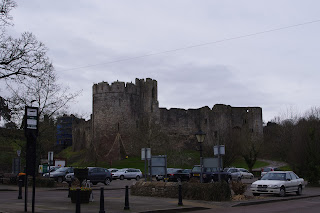
Chepstow Castle.
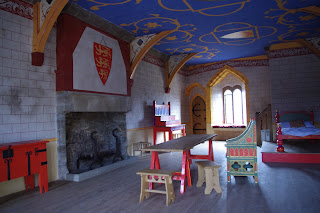
We went to Chepstow in order to get to Tintern Abbey, a longtime goal of mine.  Chepstow itself was lovely, with a friendly tourist office and a very pretty ruined castle, which originally dates to the Norman conquest of the 11th century, but which was heavily reconstructed in the 13th century.  One of the rooms had been redecorated and furnished as though it were made for a giant child from a futuristic twelfth-century.  Quite bizarre.  We got our first up-close glimpse of the River Wye there, and then headed out toward perhaps the most rickety bus I've ever seen.  It was quite adorable and held about ten people.
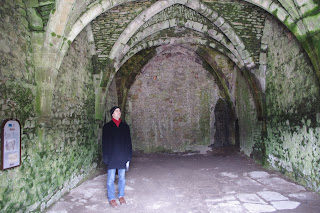
Wine cellar, Chepstow Castle.


A gaudily-decorated bedroom.
The River Wye.


"The Hotel Conneaut of Wales."


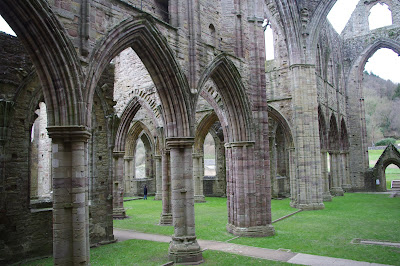
We had lunch across the street from the abbey in a hotel that reminded us of the Hotel Conneaut.  They thought our accents were funny and didn't know if we were French or American.  The waitress also thought it was totally bizarre that I would ask if there was meat in the baked beans that were to adorn my baked potato.  I explained that in America, people almost always put bacon in the beans.  She just shook her head like we were insane.  After our lunch of enormous portions, we braved the cold, misty day to explore the ruins of Tintern Abbey, an old Cistercian establishment. It was founded in the 12th century and a huge Gothic church was added in the 13th century. As part of Henry VIII's break from the Catholic church in the 1500s, all monasteries in England were dissolved and their property confiscated by the crown, leading to Tintern's ruined state today. There weren't a whole lot of other tourists there since it was a cold winter day, but we enjoyed exploring all the more.  We read every plaque there and even bought the explanatory guide book.
Tintern Abbey.

The visit starts out with a collection of ruins from the abbey, including some headless figurines and detailed motifs.  Then we went through every room at least twice.  I of course had to read Wordsworth's famous "Lines Composed a Few Miles above Tintern Abbey" since that was the inspiration for the whole trip.  I copied (legally because the copyright's been out of date for quite some time now!) the text below in case you want to read it yourself as you look at the beautiful abbey in pictures.  I didn't feel too self-conscious because there weren't many people around.  They even sold the poem for those who forgot to bring their own copy!  When it finally got too cold to stay anymore, we decided to get a cup of tea.  Instead, I changed my mind and ran back to get more pictures. (Aaron's note: Lisa was happier at Tintern than I've ever seen her, outside of our wedding day.)  Then we hopped back on the rickety bus and went back to Chepstow where we visited an antique store and had our tea.
Lisa reading Wordsworth.

We enjoyed the peace and quiet of the small town for a bit and then got on the train to Cardiff, where we had a delicious dinner of tapas, ending with churros for Aaron--the first crispy ones he's had in Europe!  We picked up our bags at the hotel and went on to the airport hotel.  On the airport bus, we met a very friendly drunk rugby fan who told us what a great bus it was.  Then we had a nice night's sleep.


LINES COMPOSED A FEW MILES ABOVE TINTERN ABBEY, ON REVISITING THE BANKS OF THE WYE DURING A TOUR. JULY 13, 1798


FIVE years have past; five summers, with the length 
Of five long winters! and again I hear
These waters, rolling from their mountain-springs
With a soft inland murmur.--Once again
Do I behold these steep and lofty cliffs,
That on a wild secluded scene impress
Thoughts of more deep seclusion; and connect
The landscape with the quiet of the sky.
The day is come when I again repose
Here, under this dark sycamore, and view
These plots of cottage-ground, these orchard-tufts,
Which at this season, with their unripe fruits,
Are clad in one green hue, and lose themselves
'Mid groves and copses. Once again I see
These hedge-rows, hardly hedge-rows, little lines
Of sportive wood run wild: these pastoral farms,
Green to the very door; and wreaths of smoke
Sent up, in silence, from among the trees! 
With some uncertain notice, as might seem
Of vagrant dwellers in the houseless woods,
Or of some Hermit's cave, where by his fire
The Hermit sits alone.
                              These beauteous forms,
Through a long absence, have not been to me
Monks' dormitory.
As is a landscape to a blind man's eye: But oft, in lonely rooms, and 'mid the din Of towns and cities, I have owed to them In hours of weariness, sensations sweet, Felt in the blood, and felt along the heart; And passing even into my purer mind, With tranquil restoration:--feelings too Of unremembered pleasure: such, perhaps, As have no slight or trivial influence On that best portion of a good man's life, His little, nameless, unremembered, acts Of kindness and of love. Nor less, I trust, To them I may have owed another gift, Of aspect more sublime; that blessed mood, In which the burthen of the mystery, In which the heavy and the weary weight
The cloisters.
Of all this unintelligible world, Is lightened:--that serene and blessed mood, In which the affections gently lead us on,-- Until, the breath of this corporeal frame And even the motion of our human blood
Almost suspended, we are laid asleep
In body, and become a living soul:
While with an eye made quiet by the power
Of harmony, and the deep power of joy,
We see into the life of things.
                                       If this
Be but a vain belief, yet, oh! how oft--
In darkness and amid the many shapes
Of joyless daylight; when the fretful stir
Unprofitable, and the fever of the world,
Have hung upon the beatings of my heart--
How oft, in spirit, have I turned to thee,
O sylvan Wye! thou wanderer thro' the woods,
How often has my spirit turned to thee!
And now, with gleams of half-extinguished thought,
With many recognitions dim and faint,
And somewhat of a sad perplexity,
The picture of the mind revives again:
While here I stand, not only with the sense
Of present pleasure, but with pleasing thoughts
That in this moment there is life and food
For future years. And so I dare to hope,
Though changed, no doubt, from what I was when first
Cupboards in the refectory.
I came among these hills; when like a roe I bounded o'er the mountains, by the sides Of the deep rivers, and the lonely streams, Wherever nature led: more like a man Flying from something that he dreads, than one Who sought the thing he loved. For nature then (The coarser pleasures of my boyish days, And their glad animal movements all gone by) To me was all in all.--I cannot paint What then I was. The sounding cataract Haunted me like a passion: the tall rock, The mountain, and the deep and gloomy wood, Their colours and their forms, were then to me An appetite; a feeling and a love, That had no need of a remoter charm,
The church.
By thought supplied, nor any interest Unborrowed from the eye.--That time is past, And all its aching joys are now no more,
And all its dizzy raptures. Not for this
Faint I, nor mourn nor murmur, other gifts
Have followed; for such loss, I would believe,
Abundant recompence. For I have learned
To look on nature, not as in the hour
Of thoughtless youth; but hearing oftentimes
The still, sad music of humanity,
Nor harsh nor grating, though of ample power
To chasten and subdue. And I have felt
A presence that disturbs me with the joy
Of elevated thoughts; a sense sublime
Of something far more deeply interfused,
Whose dwelling is the light of setting suns,
And the round ocean and the living air,
And the blue sky, and in the mind of man;
A motion and a spirit, that impels
All thinking things, all objects of all thought,
The church.
And rolls through all things. Therefore am I still A lover of the meadows and the woods, And mountains; and of all that we behold From this green earth; of all the mighty world Of eye, and ear,--both what they half create, And what perceive; well pleased to recognise In nature and the language of the sense, The anchor of my purest thoughts, the nurse, The guide, the guardian of my heart, and soul Of all my moral being. Nor perchance, If I were not thus taught, should I the more
Suffer my genial spirits to decay:
For thou art with me here upon the banks
Of this fair river; thou my dearest Friend,
My dear, dear Friend; and in thy voice I catch
The language of my former heart, and read
My former pleasures in the shooting lights
Of thy wild eyes. Oh! yet a little while
May I behold in thee what I was once,
My dear, dear Sister! and this prayer I make,
Knowing that Nature never did betray
The heart that loved her; 'tis her privilege,
Through all the years of this our life, to lead
From joy to joy: for she can so inform
The mind that is within us, so impress
With quietness and beauty, and so feed
With lofty thoughts, that neither evil tongues,
Rash judgments, nor the sneers of selfish men,
Nor greetings where no kindness is, nor all
The dreary intercourse of daily life,
Shall e'er prevail against us, or disturb
Our cheerful faith, that all which we behold
Is full of blessings. Therefore let the moon
Shine on thee in thy solitary walk;
And let the misty mountain-winds be free
To blow against thee: and, in after years,
When these wild ecstasies shall be matured
      
Into a sober pleasure; when thy mind
Shall be a mansion for all lovely forms,
Thy memory be as a dwelling-place
For all sweet sounds and harmonies; oh! then,
If solitude, or fear, or pain, or grief,
Should be thy portion, with what healing thoughts
Of tender joy wilt thou remember me,
And these my exhortations! Nor, perchance--
If I should be where I no more can hear
Thy voice, nor catch from thy wild eyes these gleams
Of past existence--wilt thou then forget
That on the banks of this delightful stream
We stood together; and that I, so long
A worshipper of Nature, hither came
Unwearied in that service: rather say
With warmer love--oh! with far deeper zeal
Of holier love. Nor wilt thou then forget,
That after many wanderings, many years
Of absence, these steep woods and lofty cliffs,
And this green pastoral landscape, were to me
More dear, both for themselves and for thy sake!  1798.

Sunday, March 4, 2012

UK Trip: Cardiff

The Mouth of the Severn.
On Sunday, we left Canterbury for the next stop on our British tour (and the last stop starting with a "Ca"!). We took the bus to London (stopping along in the way in a very strange new shopping center that appeared to be located in the bottom of an old quarry) and then transferred to a bus to Cardiff, Wales. Essentially, we traveled across most of the width of England by bus, arriving in Cardiff mid-afternoon. Traveling by bus (or train, for that matter) is really quite a nice way to see the countryside. Starting from Canterbury, I commented to Lisa that, while the rolling hills in the area were very nice, early English settlers in America must have been completely flabbergasted by the size of the rivers and forests and the Appalachians when they first saw them. By the time we got to South Wales, though, I changed my tune. Settlers from that region would not have been surprised at all by the American landscape! But unfortunately for me, I slept through one of the more dramatic parts of the western English/eastern Welsh landscape - the Severn Estuary, where the River Severn (the longest river in Britain) empties into the Atlantic. Lisa told me later it was a pretty impressive river and bridge.

Cardiff, full of people.
Once in Cardiff, we walked from the train station (where the bus dropped us off) to our hotel, one of the rather nondescript budget hotels that are part of the Ibis chain here in Europe. After dropping off our bags, we headed out to see what we could of Cardiff in the few hours of daylight we had left. Central Cardiff is an amazingly compact area. A ten minute walk is about all you need to cross it. We were also amazed at how many pedestrian-only zones there were and how many people were out walking and shopping on a Sunday afternoon. Maybe we've gotten used to France where everything shuts down on Sundays, but, as Lisa said, Cardiff may be one of the most people-filled cities we've been in.

We ended up at Cardiff Castle, which is a very cool place. It dates back to the Norman conquest of
Interior of Cardiff Castle with the Norman keep.
The house in the castle.
England in the late eleventh century, but there are plenty of more modern parts, too. We started in the house because the guy at the ticket window said it was the part of the castle that closed first. The house was built in the 1870s by the last family to own the castle and it's all in a faux-medieval style with lots of stained glass, painted wall scenes, and dark wood. The dining room had a balcony for musicians to perform, just like a medieval castle hall would have had, and the library was decorated with coats of arms and wooden carvings above the fireplace meant to symbolize ancient languages like Egyptian, Greek, Assyrian, and Hebrew. The whole place was pretty over-the-top, but it would have been quite an amazing place to live! We then left the mansion part and climbed to the top of the old Norman keep in the center of the castle. The view to the south over the city of Cardiff was obscured by all the new construction (especially the soccer stadium) but the view to the north over the hills of South Wales was very picturesque. After the keep, we
Wartime tunnels in the castle wall.
checked out the World War II-era tunnels built into the exterior wall of the castle to protect the population of Cardiff from German air raids. We then walked around the castle green for a little bit before leaving the castle about five minutes before closing at 5 pm. I'm pretty sure there only two people in there who left after we did!

The dining room. (Remember, it's not actually medieval.)
The library.
Euripides in the library.

The five ancient languages.

Wall decorations.
 
We wandered around a little bit and stumbled upon the St. John the Baptist parish church in the center of Cardiff, part of the Church in Wales (their version of the Anglican Church). We saw they had an evensong service at 6 so we decided to stick around for that. We looked around the church, which was very pretty and mostly (I think) from the 19th century. The service was preceded by some fantastic bell-laying in the belfry and the service itself was quite nice. There were about a dozen people or so there and (since there was no choir) a lot more congregational interaction that at the King's College evensong on Friday night. Afterwards, an older gentleman chatted with us, as did the vicar. They were both very pleasant and, after hearing that we were going to Tintern Abbey the next day, the vicar told us about her 70-mile walk along the River Wye that she had once done. Both of them seemed very glad that we were visiting Cardiff and Wales.
View of northern Cardiff from the Norman keep in the castle.

We had dinner across the street at a pub so I could get some fish and chips. More importantly, I had a local ale, Double Dragon, which was quite good and - Lisa liked it! This is a first in our relationship, me having a beer that she actually likes, too. Unfortunately, I don't think we'll able to find this beer in the US so now the challenge is to find a beer in America that Lisa will drink. Following dinner, we found a taxi stand to get a cab back to the hotel because we didn't want to walk back in the dark. When we climbed in and told the driver where we were going, he said it was just a five-minute walk away and that there was no reason for him to take us! He gave us directions and we walked, although I think it was a bit longer than five minutes!

Aaron in the stocks.
Lisa not in the stocks, with Cardiff
behind her.
Most of Monday was spent in Chepstow and at Tintern Abbey (about 35 or 40 miles east of Cardiff) so Sunday afternoon was really our only time in Cardiff. It seemed like a nice city, but by and large, it didn't seem like there was a lot to do there other than shopping and sports (both soccer and rugby are very big there). In fairness, though, we didn't make it to the National Museum of Wales (which is supposed to have some cool exhibits) nor down to Cardiff Bay (which is supposed to be a revitalized area of town full of restaurants and bars and a nature trail in what was the city's old coal port). Still, the highlight of the trip to Wales was Chepstow and Tintern Abbey, which we'll tell you about in the next entry.

Thursday, March 1, 2012

UK Trip: Canterbury

The trip to Canterbury got off to a rather inauspicious note. The bus we took from Cambridge to London left about 15 minutes late because one of the passengers had a difficult time explaining to the driver that he had already purchased tickets on-line. We're not sure exactly what happened (we were near the end of the line and this passenger was on the bus explaining it all to the driver) but it seemed to involve several phone calls and repeatedly checking the passenger's smart phone. The driver was clearly annoyed that this guy was going to make him late. We, on the other hand, were just nervous because we only had 40 minutes between buses in London!

Big Ben! From a bus window!
The bus ride lasted about an hour and forty-five minutes and, upon entering London, took a scenic route past the Tower of London, the Houses of Parliament, and Westminster Abbey. We arrived about 15 minutes late and then learned that our bus to Canterbury had been canceled because of mechanical problems so we had to wait an hour for the next scheduled bus. This ride, too, was about two hours long and it meant that we arrive in Canterbury later in the afternoon than I had originally planned, giving us much less time to see the city's sights. However, while waiting for the bus, we saw a strangely dressed couple: a young woman in what I can only describe as a princess dress with a tiara and a young man in a priest's black shirt and collar. He may have been a priest or it may have been a costume, but either way, we have no idea why the girl was dressed like a princess. Perhaps an early Carnivale celebration or something?

The B&B.
The first thing we did was walk from the bus station in Canterbury to the bed and breakfast where we were staying, which turned out to be a longer walk than I anticipated. However, once we found it, it was quite charming. The neighborhood was rather commercial, but the house itself dates from the 1930s and the owners, Roger and Nathalie, have done a nice job of decorating it and making it very welcoming. Roger was also very helpful in giving us directions around Canterbury and telling us things to do. We decided to head back to the city center to see the cathedral, although by this time is was almost 3:30 and we'd lost much of the day. In addition, it started to rain, making it even less pleasant!

Christchurch Gate, the entrance to the
grounds of Canterbury Cathedral.
Still, the cathedral was worth it. We arrived to hear the end of the Saturday evensong service (and I hadn't even thought, until that point, of scheduling the trip so as to be able to attend the regular Sunday morning service) and then we walked around the cathedral, seeing the tombs of a king and queen as well as the "Black Prince," Edward (who was the scourge of the French in the fourteenth century before his death in battle) as well as some lovely stained glass windows. As Lisa pointed out, unlike in Chartres, the stained-glass windows were set much lower in the wall and much closer to the viewer. It was thus much easier to appreciate not only their artistry and beauty but also the visual story they tell. We also saw the part of the cathedral where the chapel of

The Cathedral (obviously).

Saint Thomas a Beckett used to be located before it was destroyed by Henry VIII. Thomas a Beckett had a running feud with an English king in the twelfth century and, after being murdered by the king's men in the Canterbury Cathedral, was canonized. Henry VIII was no fan of this symbol of the church's triumph over a political leader, so he did what he could to destroy that symbol. Because the cathedral closed at 5:30, workers began closing off parts of the church when there was no one left in them, meaning we were unable to see some parts, such as the crypt and the spot where Thomas a Beckett was murdered. We did, though, walk outside a bit to see the cloisters (although it looks they're doing some kind of construction there so a lot of it was roped off).

The Cloisters.
Lisa at the lectern.
Stained glass window, up close and
personal. (Note: windows may appear
bluer than they are in actuality!)


After being almost the last people out of the church at five, we walked around for a bit (sometimes in very heavy rain!) before finding a place to eat, a rather charming restaurant that reminded me of where we ate on Mont Saint-Michel. We then took a cab back to the B&B rather than walk through the rain and the dark.

The next morning dawned clear and sunny. We had to catch an 8:25 bus back to London so we had breakfast at 7:30 (Roger and Nathalie kindly accommodated us by feeding us a half hour before normal). It was very good and quite nice to have a home-cooked meal. Roger also chatted with us a bit while we ate but sadly we didn't meet Nathalie - our hunch is that she was still in her bathrobe in the kitchen and didn't want to come out! All in all, it was a very nice place to stay and I regret that we were there only one night and didn't really get to enjoy the full bed and breakfast experience much. Also, it seems like a place that caters to British tourists with cars so I imagine they don't get a lot of people like us who only stay one night!

The B.
The &B.


We took a bus into Canterbury to save time and we hustled from the bus station to the gates of St.
St. Augustine's Abbey! From behind a locked gate!
Augustine's Abbey, the ruins of a monastery built on the site of a sixth-century century built by St. Augustine when he converted the Angles and Saxons to Christianity. We knew the abbey wouldn't be open yet, but since it's the other major sight in Canterbury, we wanted to try to see it through the gate, as difficulty as it may be! I've been there before, but I felt bad for Lisa because she loves ruined monasteries and cloisters. We took a couple pictures, then hustled back to the bus station for our bus to London. We got there just as the bus was pulling in, making our timing that morning impeccable.

My one regret for this portion of the trip is that I didn't budget enough time in Canterbury to really see everything and the problems with the buses compounded that. Still, I suppose that just means we'll have to return someday.

Sunday, February 26, 2012

UK Trip: Cambridge

Entrance to King's College
This past week, we've been on our mid-term break and we spent much of that time in the United Kingdom. The primary reason for going was that Lisa was invited by a colleague, Bill Burgwinkle, to present a paper at St. Catherine's College in Cambridge University. Because of that and because we had the week off, we decided to spend some time traveling around the UK to Canterbury, Cardiff, and Edinburgh after we left Cambridge.

To get to Britain, we flew directly from Rennes to Southampton, about an hour flight. Now, the Rennes airport is pretty small. It doesn't own any of the standard bridgeways to the aircraft, so we had to walk out of the airport, across the tarmac, and board the plane through the old-fashioned stairways. We sort of felt like we were in a 1950s movie or something! Plus, the discount airline we flew (Flybe) only owns a few actual jets. The rest of their fleet is turbo-prop planes and that's what we took to Britain. I don't think I've been on a turbo-prop plane in 15 years!

Guest room at St. Catherine's College
Once in Southampton, it took us a little bit of time to get through passport control, I think because 1) unlike everyone else on the plane, we're not EU citizens; 2) the woman who checked our passports was in training and wasn't entirely sure what questions she should be asking; and 3) the UK immigration service has been under political fire lately for being overly lax at border control points. So we were asked a lot of questions about who we were, where we going, how long we were staying, why we were in France, how long we'd be in France, etc. Anyway, after getting through passport control, we took the train from the airport train stop to London, transferred across town on the Tube to another train station, and took an express train to Cambridge. We got a cab from the station there to St. Catherine's College where we stayed in a very nice guest room (although the porter on duty at the college gate wasn't terribly friendly!). After we dropped our bags off, we had dinner with Lisa's colleagues and hosts then she presented her paper to a small group of graduate students, faculty, and undergraduates. It was a rousing success, if I do say so myself!

Richard Lloyd Morgan, 
standing in triumph on 
the roof of King's 
College Chapel


The next morning, we moved our stuff to King's College, where Lisa's colleague had arranged a guest room for us, and dealt with much friendlier porters. We then met Richard Lloyd Morgan, chaplain of King's College, who's a friend of a friend of Lisa's mom. Even though he had e-mailed us the week before to tell us he would be happy to talk to us and show us around, once we met him, he didn't seem to have any idea who we were. Still, he was very pleasant and we had a lovely cup of tea in his office while getting to know each other. Near the end of our conversation, he told us that at 10 am, he was leading a tour of newcomers to Cambridge on the roof of King's College Chapel and would we like to join it? Naturally, we said yes!

On top of the ceiling of the King's
College Chapel
The tour was great. We got to meet some of the people in the group, including two younger American women whose husbands are getting degrees at Cambridge and an elderly American woman who lives in Cambridge and volunteers to help with this newcomers' group. Anyway, we started by climbing 85 steps to the vault between the top of the chapel's ceiling and the beams of the roof. Richard walked us along on top of the ceiling while telling us a little about the chapel's construction history, then we climbed more steps in a corner tower to come out on the roof of the building, several stories up. We walked along the edge of the roof (fortunately, the parapet was tall and thick so there was little danger of falling over the side!), climbed over the top gable, walked along the other side,
The roof of King's College Chapel

then climbed back over the roof to the first side to get back to the stairs and the exit. Climbing over a pitched roof with nothing to hold on to was a little nerve-wracking, but everyone survived! It was also an overcast day with a kind of misty rain, which meant that, unfortunately, the views from the top of the chapel weren't as dramatic as they might have been on a clear day. At the end of the climb, we learned that there was a 93-year-old woman who was with us that day and had wanted to go on the roof her whole life.  Life goal: accomplished!

Cambridge from the roof of King's College Chapel

Scaling the roof of King's College Chapel
Once we got back to the floor of the chapel, the tour continued with one of the women who organizes this newcomers' group (whatever it is). She led us through the chapel proper, explaining more of the construction history and some of the iconography of the decorative carvings and the stained glass. It was very informative and the chapel is a truly beautiful space.

At the conclusion of the tour, we thanked Richard and headed off to meet Bill in his office for lunch. His office is exactly like the offices of
Bill's office is the window to the right of Henry VIII!
Cambridge/Oxford professors I've seen on British TV shows - big, with tall windows, comfy couches, and stacked to the ceiling with books. He took us for lunch to the Fellows' Room in King's College, a sort of private lounge where Cambridge professors can sit and order lunch from the kitchen. It was very nice and a little awe-inspiring to know we were surrounded by some of the most prestigious intellectuals in the world. The lunch was delicious, too, including the pea and mint soup, which is not a combination you'd think would be good, but it was. It was very kind of Bill to take us there and after we finished, we thanked him and headed out to explore more of Cambridge.

Interior of King's College Chapel
Like any good academic town, Cambridge if full of used book stores and Lisa and I went to a couple because used book stores are one of my favorite things in life. We found a lot of good treasures at G. David's, including a guidebook to Edinburgh from the 1950s for 50p. We also happened to be in Cambridge the weekend of a large used-book fair, which we saw advertised in banners hanging over the street. It cost a pound a piece to get in, but it was worth it. There were all kinds of antiquarian books, many from the eighteenth and nineteenth centuries. I was on the hunt for two kinds of books in particular that I collect - either Macmillan commentaries (little red classical texts and commentaries published from the 1880s through the 1930s) or old Baedekers (little guidebooks to Europe published from the 1860s to the 1920s). I found many Baedekers, although they weren't very cheap. But I decided to splurge and buy a 1909 guide to northern France in remarkably good condition.

This is where we sat for the evensong service.
Following the book fair, we walked to the Fitzwilliam Museum, Cambridge's art and classical archaeology museum. Unfortunately, we got there only about an hour before closing, so we didn't have time to see much more than the Greek, Roman, medieval and Renaissance stuff. It was all very nice, but it wasn't anything spectacular. After, that, we walked back to King's College to go to the 5:30 evensong service, led by Richard. We saw him on the way in and he told us to tell the usher that we were guests of the college, because that would mean we could sit in the fancy wooden choir stalls with any of the college fellows who were present, rather than in the regular pews with the tourists. It was nice of him to suggest that and it was really cool to sit in the choir stalls, closer to the amazing King's College boys' choir. The service was very lovely and the choir sang beautifully. It was also very cool to be in the chapel at the end of the day; that meant that when the service started, the stained glass windows were still well-illuminated, but by the end of the service, they were completely black. On the way out, we thanked Richard (once again) for his generosity and hospitality.

King's College guestroom: not as fancy schmancy as
St. Catherine's, but still quite nice.
After the service, we went back to our room at King's College (which wasn't nearly as fancy as the one in St. Catherine's College) then headed out for dinner at an ethnic restaurant that somehow served Greek, Indian, Italian, and Czech food all at the same time!

The next morning, before we left, we got some more pictures of King's College chapel and, on the way from our room to the chapel, we were stopped by a porter wanting to know why were in the college (since it was closed to visitors). We explained that we were guests and had spent the night. He then asked what room we were in so we pulled out the key to show him. That was proof enough and he let us go on our way, but at least he was amazingly pleasant and not rude about it! We then walked across town to the park where the coach buses stop ready for the next stop on our trip: Canterbury.