Showing posts with label Travel. Show all posts

Friday, September 7, 2012

The Voyage Home

Our last view of Rennes: the train station.
We took a direct train from Rennes to Charles de Gaulle Airport and we're very glad we did. After our horrible experience trying to drag three huge suitcases up and down stairs in the Paris Metro on our way to Rennes in August, we were not going to repeat that. Our train got in around 5:30 and we checked into the Ibis hotel at the airport. We spent some time re-packing suitcases, trying to balance out the weight so that we wouldn't have to pay an overweight baggage fee. Around 7, we took the Paris commuter train into central Paris for dinner. We thought it would be depressing to eat our last meal in France at a crummy airport restaurant and that we should go into Paris one more time before we left.

Lisa's risotto at L'Ardoise Gourmand.
Since we didn't want to spend a lot of time traveling in the city, we decided to find a place near the Gare du Nord train station (the biggest, oldest, and busiest train station in Paris, by the way), the first stop the train made in central Paris. I looked up some places on-line before we left the hotel and once we got to the station, we wandered up a big street but didn't see anything too appetizing. So we turned down a side street and came upon L'Ardoise Gourmand, a restaurant I had seen on-line as being pretty good. It seemed reasonably priced so we decided to check it out. It was a pretty small place and very crowded and we got one of the last non-reserved tables. The service was a bit slow because one of the waiters didn't show up for work that night so there was only one waiter for the whole place. Beyond that, though, it was fantastic, easily one of the two or three best restaurants we've been to in France. It was full of local regulars who clearly knew the owner, Francois. He walked around the room talking to almost everyone since he knew them all. The food was fantastic. I had pesto bruschetta with a mixed salad with delicious dressing (a rarity in France - they don't know how to make interesting salad dressings for some reason) and for my main course I had a very tender cut of beef with an amazing wine/vinegar/shallot sauce and pureed potatoes. Lisa had a green bean salad and a tasty mushroom risotto. Lisa said she felt very classy eating there, despite being tired from so little sleep the last few days. It was definitely a restaurant we'd go back to next time we're in Paris - and next time, we'll make reservations!

Speaking of which, we saw a Chinese tourist couple in the restaurant who figured out how to defeat the waiter's excuse of "no reservations? we're full, sorry!" When told that there were no tables, the couple said (in English, of course), "We'll wait for a table." The waiter said, "But there are no tables." The woman said, "No, you don't understand. We want to eat here. We'll wait till there's a table available." The waiter had no idea what to do because in France, you don't wait for a table; if the restaurant's full and you don't have reservations, you leave and find a different restaurant. So he quickly found an empty table for them! Similarly, a man came in shortly after they did, was told there were no tables, so he made a reservation on the spot for a table in half an hour or so. He came back half an hour later only to find that the table he'd reserved had been given to someone else. So he calmly explained to the waiter, "I reserved that table and I would like to have it please." He waited patiently in the doorway for about ten minutes with his wife and daughter until the waiter moved the people at "his" table to another one. It was all a very interesting lesson in French restaurant etiquette, although I felt bad for the waiter since he was clearly overwhelmed that night.
Gare du Nord at night.

We left the restaurant around 11 and getting back to the airport proved to be an adventure. When we got  back to the Gare du Nord, we discovered there were no more trains out to the airport, which meant we might have had to take a very expensive cab back. But we saw a rather lost-looking young Chinese woman with a suitcase on the platform. Lisa approached and asked if she was going to the airport. She said she was and said that, as far as she understood, we could take a train close to the airport then take a shuttle bus the rest of the way. She didn't sound entirely sure, so we found a security guard and asked if that was true and he said yes. So, with the Chinese woman, we took a train to Aulnay-sous-Bois then found a bus to the airport. Unfortunately, the express bus was completely full by the time we got out of the station, so we had to take the "slow" bus that made all the intermediate stops. (Apparently, this is all necessary because of night-time track work on the line to the airport.) We didn't get back to the hotel till around 1 am, much later than we anticipated. We had a nice chat with the Chinese woman, though; she was leaving the next day for Russia where she was going to study. She was also so amazed that we were Americans returning to the US. I think we were the first Americans she'd ever met!

We essentially took a nap in the hotel, since we had to be up a bit after 5 in order to get to the check-in desk for an 8 am flight. Miraculously, we didn't have to pay extra for our bags, even though we had an additional checked bag and more weight than we should have had under Iceland Air's policy - but hey, we're not complaining! We flew through Reykjavik, meaning our first flight was about three hours long and our flight on to Boston was about five hours. We had an hour in the Reykjavik airport which we spent tasting Icelandic doughnuts and yogurt in the food court area. We saw two young tall Icelandic women with long blond hair each buying a big bottle of beer there, too. It was only 9:30 am, but, as I said to Lisa, these people are the descendents of Vikings, so of course they're going to start drinking first thing in the morning!
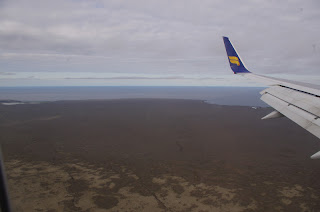
Iceland.
We also began to acclimate ourselves to being around Americans there, too, as the flight to Boston was almost all Americans. In the Reykjavik airport, there are no gate announcements of any kind - you just go to your gate, they eventually open the door, and you get on the plane. This caused a great deal of confusion for an older American couple behind us in line: "What's going on?" "The door's open. Are they boarding?" "I don't know; I didn't hear any announcement." "Well, people are going through. Should we go?" "I'm not sure. What rows are they boarding?" "I don't know, there was no announcement. Are we supposed to go?" And on and on. It was annoying and funny all at the same time. Also on the plane, there was a young British man sitting in the row behind us and we're pretty sure he didn't stop talking the entire flight, except when he was eating. He talked to the man next to him (whom we never heard speak) about everything under the sun: his job, flying, British monetary policy, the Icelandic language compared to other languages, living in a foreign country. It was amazing that he wasn't hoarse by the end of the flight!

Icelandic volcanoes.
From what we could see from the plane and through the airport windows, Iceland is a beautiful country. It's very flat, except for the many volcanoes, without a lot of trees or plants. Many of the volcanoes seemed to rise directly out of the ocean. We both think it would be a fun country to visit and hike around in for a week. Plus, since it's only about half-way to mainland Europe, flights are less expensive and Iceland Air has direct flights from Minneapolis-St. Paul to Reykjavik, which might come in handy for us next year!

Icelandic coastline.
Once in Boston, we went through customs, which really didn't take that long. Again, it was like an overload of Americans. We just weren't used to interacting with so many native English-speakers and so many overly-friendly people! On the customs form, we had to fill in all the countries we've visited since we last left the US. We actually ran out of room and had to write below the line to get them all in (for the record: Iceland, Ireland [airports only for both of those], France, the UK, Belgium, Germany, Italy, Greece, Switzerland).

After customs, we indulged in some good trashy American food by eating a burrito and a burrito salad in the food court. Immediately, we were struck by how much saltier our food was than anything we'd had in France. Then it was off to our flight from Boston to Pittsburgh, where Lisa's mom was waiting to pick us up and take us back to their house, thus ending our wonderful nine-and-a-half-month European adventure.
Sunday, September 2, 2012

Matt's Visit and Packing Up


Meeting Matt at the train station.
We returned to Rennes from our travel-ganza late on a Friday afternoon and my brother Matt was waiting at the train station to meet us. He was in the midst of a month-long European adventure across Spain, France, Germany, Portugal, and the Netherlands. His bus go to Rennes early that Friday morning so he had about seven hours on his own to explore Rennes and we hope he did. He said that he tried to take a nap in one of the city's parks because he didn't get much sleep on his night bus from Spain to Rennes.

Part of the map-covered bedroom.
Lisa and I both felt bad that we couldn't provide Matt with the same kind of hospitality we've given other guests because, after returning to Rennes, we had three days before we had to vacate our apartment and return to the US. That meant that we had a lot of packing and last-minute errands to do. It also meant that every day Matt was there, someone came by to pick up pieces of furniture they'd bought from us. So every day, we changed what piece of furniture we sat on or ate off of! It was a little sad to pack up everything we own, especially all the maps we'd hung up in the bedroom and the postcards we'd put in the toilet room. In every city we visited this year, we got a map from the tourist office and, when we returned home, hung them on the bedroom walls as decoration and as a reminder of all the amazing trips we took. Similarly, in the toilet room, we hung up a postcard from nearly every city we visited. Returning to bare white walls was a bit depressing!

On the other hand, it was exciting to know that we were just a few days away from returning home to the US and our friends and family. It was stressful few days, though, of canceling our utilities, cleaning, and trips to the post office to mail boxes of books, maps, and brochures home because it was cheaper than paying the overweight baggage fee on the plane. Also, once we started boxing and mailing things, it was surprising how much we had accumulated in France - admittedly, not much by American standards, but quite a lot in proportion to how much we brought with us. Mainly it was maps and books we had purchased, but then again, this blog is called "Running and Reading in Rennes" so you shouldn't be surprised we bought a lot of books.

Our cheese-mongers.
Our apple-seller.
Amidst all the packing and selling and moving, we were able to do a few things with Matt in our area. On Saturday, we took him to the market where we were able to buy some last good fresh French produce and cheese and say good-bye to the many vendors we had become familiar with over the course of the year. They were as sad to see us go as we were to say good-bye to them! We were very happy the cheese-mongers agreed to pose for a picture for us.  We also went into central Rennes that afternoon to go to a record store. Since had Matt hadn't brought any good-sized sturdy luggage, though, he didn't want to try to take records home with him so he bought a few cassette tapes instead. Also downtown, we saw part of what passed for Rennes' Gay Pride Parade and Matt listened to and recorded a good gospel choir singing to advertise their church.
Gay Pride Parade, French-style.

Thursday, July 5, 2012

Lyon, or, Like the Romans, We Crossed the Rhone

Avignon and the Rhone from the train.
We took an early-morning train from Avignon to Lyon. Unfortunately, this meant taking an even earlier shuttle to the train station because the new(ish) station serving high-speed trains through Avignon is several miles outside of town while the older station serving "normal" trains was just a short walk from our hotel. Once in the new station, we were surprised by the large number of Germans hanging around. Only when we got on our train with them did we realize that the train continued on through France to Frankfurt, Germany, so presumably these were all tourists on their way home.

Fourvière Hill with the basilica and the Eiffel Tower look-alike.
Lyon from the summit of Fourvière Hill.
Mont Blanc is somewhere in all that haze.
We got to Lyon mid-morning. It's almost straight north up the Rhone from Avignon so it marks the point at which our "Circle Tour of France" made the big turn northward to start heading home. Lyon is in the Rhone-Alpes region, my fourteenth region (2/3 of the way to seeing every region!) and Lisa's fifteenth. Lyon is the third-largest city in France and it's situated at the confluence of two major rivers, the Rhone and the Saone, with a a huge steep hill behind it - not unlike Pittsburgh, actually. This strategic position appealed to the ancient Romans, who founded the city in the first century BC, and it became the most important city in Roman Gaul. After a day in Arles, I was excited about continuing my tour of ancient Roman cities in southern France!

Hotel staircase.
We started by taking a bus across town from the train station to "old Lyon," the medieval/Renaissance part where our hotel was located. The desk clerk was SO friendly and helpful! He gave us a map, a booklet about old Lyon, restaurant recommendations, sights to see, where to get the best views of the city, where to get the best ice cream - everything we could possibly want to know. He was better than a tourist office and gave us a good impression of Lyon right away. The hotel itself was charming - on a pedestrian street in an old building with a spiral staircase and all the rooms opening onto the staircase. The hotel was one of the original post offices when it was first established in France.  As a result, it slanted just a bit!

Stairs up the hill.
From there, we walked back the way we came across the Saone River to the Saturday market we saw lining the river. We foraged for supplies for a picnic lunch: bread and cheese (of course) plus a lot southern produce we don't really have in Cesson - cherries, olives, and watermelon. We also got a huge hunk of nougat to take home to the US to share with Lisa's mom. We decided to have our picnic lunch on top of Fourvière Hill, the huge hill behind old Lyon. It was a good idea, but we stupidly decided to walk up the hill rather than take the funicular. (Lisa adds that she ended up being very cranky while sweating up the hill in a sun dress.)  It was a hot, sunny, muggy day and climbing hundreds of steep steps up a 950-foot-tall hill was not fun. However, we enjoyed our picnic at the top, cooled down, and got some great views from the summit looking east over the city. In fact, we could even see Mont Blanc, the highest peak in the Alps and about a hundred miles away on the French-Italian border!

Basilica of Notre-Dame de Fourvière.
The summit of Fourvière has a couple features that make it like a mini-Paris. First, there's the funicular up the hill, similar to the one in Paris going up the hill of Montmartre (although Lyon's is older). Second, there's the Tour Metallique, a 19th-century tower that looks like the upper portion of the Eiffel Tower. Third, there's the Basilica of Notre-Dame de Fourvière, built in the late 19th century to thank the Virgin Mary for saving Lyon from the Prussians during the Franco-Prussian War (sort of like Paris' Sacre-Coeur being built in the same time period to ask God's forgiveness because of the "divine punishment" of the French defeat by the Prussians). The basilica is very different from Sacre-Coeur, though. It's not as big and it's built in more of a traditional western church style than the neo-Byzantine architecture of Sacre-Coeur. Inside, there are lots of mosaics dealing with the life of Mary and her miraculous interventions in French history. Sadly, there's a large restoration project in the works right now so there was a lot of scaffolding (like so many other churches we've visited this year!). Below the main sanctuary is a much-less ornate one dedicated to Joseph - apparently the money ran out after completing the Mary-centric upstairs!

Joan of Arc mosaic from the basilica.
Outside the basilica, we refilled our water bottle at a public water fountain and met a young American couple doing the same thing. They knew we were American because of our stainless steel water bottle, they said; no French person would carry something like that! They're from Portland, Oregon, but they've been working in Paris for the past year (they didn't say specifically what they did) and were now traveling around France, much like us. It was strange to meet our doppelgangers.

Roman theater.
Part of a chariot race mosaic, Gallo-Roman Museum.
This guy obviously did not win the race.
Also on top of the hill are the remains of two ancient Roman theaters and the Gallic-Roman Museum. The Roman city was actually located on the top of the hill and it was only in the Middle Ages that this area was abandoned as the population moved down to the lowlands along the rivers (probably because the aqueducts stopped working and they needed fresh water - that's Lisa's guess). We looked at the theaters from the outside but didn't go in and climb around. I had my fill of provincial Roman theaters the day before at Arles. Plus, it was so hot and humid that we preferred to go inside the museum. It was fantastic, probably the best collection of ancient Roman material I've seen outside of Italy (although, to be fair, I haven't seen much ancient Roman stuff outside Italy). I think it was more interesting and better-explained than even the Louvre's collection. It was one of the few places where I commandeered Lisa's camera to get pictures of the inscriptions, funerary monuments, statues, mosaics, and sarcophagi, all of which I can hopefully use the next time I teach a class on Roman civilization. (I could post tons of pictures here, but I won't since most of them are probably only of interest to classicists like me!)
Traboule (covered passageway).

Cathedral.
After the museum, we walked back down the hill into old Lyon - a much easier walk than coming up. We did some shopping at an artisanal honey store, a used book store, and a stained glass store. We also walked through one of the traboule, the covered passageways that were constructed in the Renaissance to link two parallel streets by going through the courtyards of the buildings between. They were meant to protect the skeins of silk as they were moved between workshops (Lyon was a major silk-production center in the Renaissance). We checked out the cathedral, which was just a big Gothic church. Most of the exterior sculpture was destroyed during the French Revolution. The only real distinguishing feature that I noticed was that the tower of the church wasn't the pointy Gothic spire you see on northern churches but a squat square tower in the Italian style, like what one sees on old churches in Rome. We also looked at the "archaeological park" next to the cathedral which contained the remains of very old churches pre-dating the cathedral. In fact, Lyon claims to have the oldest Christian community in France.

Dramatic clouds, but where's Jesus or Mary?
We had dinner in old Lyon, too, then went to the ice cream place recommended by the hotel clerk. We shared a scoop of blood orange sorbet and it was delicious! On the walk back to the hotel, we stopped to admire the setting sun and the clouds. It was very dramatic and it looked like something out of one of the sixteenth-century paintings of Jesus or Mary we had seen in Italy the week before (although I don't think it looks as dramatic in these pictures as it did in person). After that, it was off to bed before our day-trip the next day to Geneva, Switzerland. Lyon is definitely a city I would like to which I would like to return. It was very beautiful and everyone was so friendly. It would be a great place to come spend a relaxing few days, I think.

Bonus picture for Lisa's dad: Dionysus!
The Roman Emperor Caracalla. (Or is it my graduate adviser?)
Bonus picture for Lynn: Stained-glass store.

Tuesday, July 3, 2012

Arles

Children being instructed in the finer arts of gladiatorial combat.
We went to Arles as a day trip from Avignon, since it's only a 15-minute train ride south down the Rhone River. Arles was an extremely important Roman city as it was the first bridge over the Rhone above the mouth of the river, making it a key transportation and trade crossroads. (The bridge itself was pretty ingenious. Rather than build a standard stone-and-brick bridge, the Romans constructed a permanent pontoon bridge of boats linked together that would rise and fall with the river, preventing the possibility of the bridge being washed away in a flood.) Arles thus has one of the largest and best-preserved collections of ancient Roman ruins in France.
Amphitheater

Despite the sun and the intense heat (good thing I had a new hat!), we saw as many of the ancient sites as we could in our afternoon in the city, starting with the amphitheater. It's basically a mini version of the Colosseum in Rome, but much better preserved. In fact, it's still in use today for bull fights (although unlike the Spanish version, in the Provencal version, the bull isn't killed) but this means its hard to tell what is original Roman-era construction and what is restored, modern construction. Still, you get a good feel for what an intact amphitheater would have been like.

Roman theater.
Storming the castle!
Eef you're appee ann yoo know eet...
Next to the amphitheater is the ancient theater, used for dramatic performances and dating from the first century AD. During the Middle Ages, it was used as a quarry for other building projects in the city and so while part of it has been restored, it's only about half the size it would originally have been. This, too, is still in use for summer-time outdoor plays. While we were sitting in the top row admiring the site, a large group of French schoolchildren entered. At a signal from their teacher, they all shouted and started clambering up the seats as quickly as possible. It looked like they were coming right for us! Once at the top, though, they all sat down and started singing "If You're Happy and You Know It" in English. We have no idea what it was all about, but it was entertaining to watch!

Baths of Constantine.
We also visited the Baths of Constantine, dating from the fourth century AD and only about a third of which still survives. The site wasn't well-explained and it was fairly small; it only took about ten minutes to walk through all that remains of the public baths, specifically the hot water room and the warm water room.

Cryptoporticus - but what is it?
The final ancient site we visited was the cryptoporticus, a series of three long tunnels supported by columns now in the basement of the city hall of Arles. It was built in the first century BC as a foundation for the forum of the city and used as storage or as barracks. There were no signs, it was very damp and we were the only people down there (we got in about twenty minutes before closing) and it was kind of eerie. I really have no idea what we were looking at, just that it was Roman!

Funerary statue of Medea about to kill
her children. Why would you put this
on your grave?
The Roman museum in Arles was much more interesting and much better explained. It's about a 25-minute walk from the central city and we got there about 45 minutes before they closed, so we had to kind of race through it. But they've got some fantastic sculptures from various ancient buildings and very cool models of the major Roman remains as they would have looked in ancient times. They also have some very beautiful mosaics found at some of the ritzy ancient villas across the river and there are lots of sarcophagi with amazing sculptural details. It was a great collection of material.

Church of St. Trophime
Pilgrim
Among the non-Roman sites in the city is the church of St. Trophime, built mostly in the 11th and 12th centuries. It has some very well-preserved Romanesque sculptures around the front door which look very different from the Gothic sculptures we saw all over northern France. Inside, there's a chapel chock-full of saints' relics all of them helpfully labeled (although you can't go in, you can just peer through the grate). It's the most I've seen in one place! Also, there are a couple of altars in side chapels that are actually fourth century AD sarcophagi that, at some point in the Middle Ages, were discovered and turned into altars (presumably without the bodies inside!). As we left the church, we saw a guy come in with a walk staff and a huge backpack. He went to the "welcome desk" and it dawned on us that he was making the pilgrimage to the Santiago de Compostella in Spain and was stopping off to get his pass stamped, proving that he had walked most of the way. It was kind of cool to see a modern pilgrim following the same route and seeing the same churches pilgrims did a thousand years ago.

Cloister of St. Trophime.
Attached to the church is a cloister. Half of it was built in the 12th century in Romanesque style and the other half built in the 13th century in Gothic style. The capitals of the columns ringing the cloister are supposed to be quite beautiful and have interesting individually carved figures on them, but because most of the cloister is undergoing renovation, we couldn't see them! We could, however, climb up to the second floor and see the drainage system on the roof that was used to save rain water for use by the canons of the church.

Compare and contrast: Van Gogh....
Reality.
Besides the Roman ruins, Arles is also famous as the town where Vincent van Gogh lived from 1888 to 1889. During that time, he produced many of his most famous paintings. It's also where he famously cut off his ear and was checked into the hospital before leaving town for a mental asylum not far away. Today, Arles has erected little plaques throughout the city marking places van Gogh painted and showing you a copy of the painting (none of his paintings are actually housed in Arles). So we got to see the same view he did when he painted Starry Night Over the Rhone and we walked by the cafe on Place du Forum that he painted as The Night Cafe. We also went to the courtyard of the former hospital where he stayed following the loss of his ear. The courtyard is now painted in bright colors to match a painting van Gogh did of it and the garden is also planted to match the painting.
Van Gogh's hospital.

In all, it was a pretty jam-packed afternoon in the heat of Arles. We headed back to Avignon around eight (after our train was delayed about 20 minutes) for dinner at a tapas restaurant and then bed. The next morning, we set out for the next stop on our circle tour (and another major ancient Roman city): Lyon.


Chapel of relics in Saint-Trophime.
Sarcophagus-altar at Saint-Trophime.

Sunday, June 24, 2012

Avignon

The Mediterranean from the train.
From Carcassonne, we took two trains to Avignon. Along the way, the train passed very close to the Mediterranean, no more than half a mile or so in some places, giving us some great views of the coast. Avignon is located on the Rhone River on the very western edge of the Provence-Alpes-Cotes d'Azur region ("the California of France"), a region located in southeastern France and containing such famous cities as Marseilles, Cannes, Monaco, and also the French Riviera. We didn't go that far into the region, though, and we stayed inland along the Rhone ("the Ohio River of France").

Palace of the Popes (the first time Lisa saw it, it was
celebrating an anniversary and had a big red sign, saying
"ca va durer longtemps" "it will last a long time.").
Part of the story of Ariadne.
Avignon is famous because it was the home of the Popes for about sixty-five years on the 14th century. I won't go into all the details, but because of conflicts between various factions of cardinals and between popes and the king of France, a French cardinal was elected Pope in 1309. He decided he didn't want to move to Rome and stayed in Avignon. He was followed by six more Popes in Avignon, all of them French and all of them increasingly under the control of the French king. It was only in 1377 that the Papal court was moved back to Rome (although because the Popes had purchased the city of Avignon from the kings of Sicily, who ruled the area, so Avignon wasn't united with the rest of France until 1791, following the French Revolution!). Thus, the major sights in the city relate to the period of Papal residence in Avignon.

14th-century funeral monument.
Pont Saint-Benezet
We got to Avignon in the afternoon and walked a few blocks from the train station, through the old city walls, to our hotel. There, one of the owners, Pascal, gave us a map and TONS of information about the city - what sights to see, names and locations of restaurants to try, locations of restaurants to avoid ("they're touristy - not for you," he said) and shopping areas. We then headed out to the Petit Palais, which used to be a cardinal's residence next to the Papal Palace and is now an art museum. It was almost all religious art from the 14th and 15th centuries and almost all of it was Italian. It was sort of strange to see works by the same artists we had just seen in Florence the week before! Beyond the standard "Madonna and Child"s, there were some nice things - a work by a young Botticelli, some interesting paintings from the side of clothes storage chests showing the myth of Ariadne, a cool painting of the Last Judgement and, Lisa's favorite, the remains of a late 14th-century funeral monument of a cardinal that she can reference in her dissertation. There was also an exhibit on how to restore medieval paintings, although it was all in French so I didn't get much out of it.

Lisa on the hill above the Pont Saint-Benezet
After the museum, we went next door to the Palace of the Popes. We tried to buy a combo ticket for the palace and the broken bridge of Avignon (inspiration for a French song) but the ticket guy said the bridge was closing soon and we probably wouldn't have time to see both places unless we hurried. We decided to try to get to the bridge first then come back to the palace, but we couldn't figure out how to get there. Instead, we ended up in a park on the hill above the river looking down at the bridge and then we headed back to the palace. Lisa had already visited it before, and I was okay with not actually going out on it, even if it meant we didn't get to sing the song that Lisa said was known there (Sur le pont d'Avignon l'on y danse l'on y danse. Sur le pont d'Avignon l'on y danse tous en rond).

Cloister in the Palace of the Popes.
Pope's dining room.
Pope's chapel.
Lisa had been in the palace in the summer of 2004 when she studied in Montpelier and she remembered it as being empty and boring. There were certainly very few furnishings (like the abbey at Mont Saint-Michel) but some of the rooms contained some small exhibits and interpretive plaques that seemed fairly new. As a whole, the palace seemed to be a medieval castle that just happened to be owned by the Pope: huge rooms, Gothic architecture, and lots of stone. But we both agreed it was a cool place. The size of the dining room and the chapel were awe-inspiring - you have to have room for the entire Papal bureaucracy to eat and pray! - and some of the Pope's private rooms still had some amazing frescoes on the wall (although we couldn't take pictures of those). We couldn't see the whole palace, though, because it's also now used as a convention center and so they were setting up some of the rooms for the next convention. Plus, in the courtyard, they were erecting a huge stage for Avignon's annual month-long theater festival in July. We left when we got kicked out at closing time (7 pm) and, on the way, got a free postcard in the gift shop because neither we nor the cashier had change and she just didn't want to deal with it. It was quite nice of her!

Aaron on the street outside the Popes' Palace.
Note the new hat.
After the palace, we had dinner at one of the restaurants Pascal recommended. It wasn't fancy, just good solid, cheap Provencal cooking. As we left, a small wedding party entered, fresh from being married at the mayor's office. In France, the state only recognizes marriages performed by local mayors so those are the official ones. If you have the desire, time, and money, you can have an "extra" church wedding, but everyone gets married at the mayor's office first for it to be official. Anyway, it was fun to see such a happy group of people sharing champagne and dinner.

Market hall.
The next morning, we did something very unglamorous - laundry! For the only time on one of our adventures, we decided we needed to wash clothes. We were going to be gone so long that we knew we couldn't carry enough clean clothes with us so we asked Pascal about a local laundromat, which, of course, he could direct us to. While the laundry was going, we walked to Avignon's market hall. I was expecting a good old-fashioned French market area with lots of small booths and minimal roofing. Instead, it was a modern building with lots of vendors inside, not unlike the North Market in Columbus (except Avignon's was full of American tourists for some reason!). We bought supplies for a picnic lunch - bread, cheese, olives, strawberries, and apricots - then went back to collect our laundry. As we left we gave some of our extra soap (we had to buy two pellets from the machine) to a young American kid with a huge backpack doing laundry. We imagine he's spending several months on his own backpacking across Europe! We dropped off the laundry at the hotel then headed back to the train station for an afternoon trip to Arles.