Saturday, June 2, 2012

Thessaloniki: Greek Hospitality Part 2

NB: This entry was equally written by Aaron and Lisa.

Aleka's Dad, Aleka, Aleka's mom, and Aaron.
Upper city at night.
After Athens, we flew to Thessaloniki, in northern Greece, and met up with a friend of Lisa's, Aleka (whom Lisa always has a hard time remembering not to call Alex because though that's a fine French nickname, it doesn't work well for a woman in Greek), whom she met during a summer seminar in France a couple years ago. Her family lives in Thessaloniki, too, so the first night we were there, she took us to her father's office (he's a doctor) and he showed us and explained to us the pictures he had on his wall from his younger years. Then he, Aleka's mother, Aleka, and we all went out to eat. Aleka's father kept ordering more and more food for us (Greek food is usually served family style) and making sure we were enjoying it and full! It was a lovely, welcoming dinner. The family shared Greek history, family history, conviviality and lots of generosity with us! We were overwhelmed and grateful for their kindness. Afterwards, he drove us all up into the upper city of Thessaloniki where we got to see the remains of a medieval Byzantine fortification (which now seems to be a nightly hotspot for teenagers!). They are all very proud of their home.

St. Demetrios Church. These 8th-century
frescoes survived a massive fire in 1917.
Aleka very kindly showed us around her city, taking us to a couple of fantastic churches, including the church of St. Demetrios. It's built on the site of the oldest church in the city and while it burned down in a city-wide fire in 1917, it was reconstructed exactly as it was and a few of the 11th-century Byzantine frescoes survive. She showed us the arch of Galerius, built by the Roman emperor when he lived in Thessaloniki in the early fourth century AD. Nowadays, the arch serves as a meeting point for people--"Oh, just meet me at the arch and we'll figure it out from there."

More locals--monkeys in Hagia Sophia.
Another amazing place that she showed us was the Hagia Sophia, upon which the Constantinople (now Istanbul) church was based.  While we were there, we got to experience some tourist behavior as well as local.  Alexandra's former professor was giving a tour, and he had a group of quiet, respectful English-speakers with him who listened and took lots of photographs (like Lisa).  The locals came in and kissed the icons, which we've never seen in any other church we've visited this year (as our readers, you know there have been lots!).  A man working there followed behind the old women with a bottle of windex, wiping down the icons after them.  The church was absolutely gorgeous and makes one want to visit Istanbul to see it's copy!
Arch of Galerius.

The Saturday morning that we were there, Aleka also took us to the archaeological museum (although half of it was closed because of budget cuts) where we got to see some amazing gold jewelry excavated from fourth-century BC tombs in the area. Lisa, who has done some jewelry-making from metal before, is always fascinated by the talent and skill in these pieces. Most of them belonged to very wealthy people and were found in their tombs (hence why they are so well preserved), and some were worn during the people's lifetimes at various feasts and festivals. Behind that museum is the Byzantine museum, a huge building with some nice Byzantine artifact, but also lots of empty space for some reason.

This is a view from the White Tower.
Aleka also took us to a cafe on the top floor of the chic Elektra Palace hotel overlooking the ocean for some nice views of the harbor. We felt rather helpful here because there was a lot of confusion on a lot of people's part on the elevator!  In the end, Aleka, some businessmen, some men in robes and slippers from the pool, and we all made it to our destinations. We enjoyed frappés, which are nothing like a frappuccino! Instead, they are iced coffee with very strong and very bitter foam on top. We found them delicious and refreshing.

Chrysa and Alexandra deciding what we needed to try.
At night, we met up with Chrysa, a friend of hers, and all went out to eat at a good restaurant featuring traditional Greek music, which was quite fun. The restaurant was on a street that until recently had been the home of the sex and drug industry. The government decided to clean it up and restore it to small (and some large!) restaurants with traditional food and music. It felt like a place in a cute small town instead of in the middle of a big city. We quite enjoyed it.

Aaron, rubbing Aristotle's foot for happiness. (Apparently
that's a popular thing to do, though we don't know why).
Our last day there, Aleka had to prep for class the next day, so Lisa and I explored the city on our own a bit. Thessaloniki isn't as old of a city as Athens, so the oldest remains we could see were late Roman (fourth century AD) like the ruins of Galerius' palace and a round building which would have been his mausoleum but was never used and so was turned into a church. We also got a very different vibe in Thessaloniki than in Athens (probably because in Athens, we were staying in someone's house far from the city center while in Thessaloniki, we were close to the action downtown). There were lots of young Greeks sitting out in cafes along the waterfront, enjoying the nice weather, drinking frappés. It was a nice place and it was good, I think, to see a different part of Greece than just Athens. Sadly, we didn't make it to any of the islands, which people kept asking if we were going to do. Next time we come to Greece, we will!

Our view from the restaurant and our hotel room.
As a final story, we had a great waiter at dinner our last night in Greece. We went to a little taverna next door to the hotel and greeted him in Greek and asked about the food options. The waiter quickly realized we didn't speak much Greek, so he explained the menu in English and Greek, before asking, in Greek, where we're from. We answered in Greek as best we could to which he asked, "How do you know Greek?" I explained I studied modern Greek for a year at OSU and he said, "As a Greek person, I feel very proud knowing that people in other countries want to learn my language. It's wonderful." He then asked if we were married, we said yes, he asked if we had children, we said no, not yet, and he said, "From the bottom of my heart, I wish you many children. Four, five six children - a big family! It's part of my religion and in my heart, I wish for a big, very big, family! Family is happiness." He asked how we liked Greece and we said it's our first time and we like it very much. He said, "Your first time? We must celebrate!" So he ran back inside to get a shot of ouzo for each of us and toasted our first trip in his country (it was a very long toast and all in Greek, so we aren't entirely sure what he said, but it was certainly heartfelt and very kind!). We feel this is emblematic of the kind of welcoming, friendly interactions we had with almost everyone in Greece and that, despite their political problems, this is still a wonderful country worth visiting.

A little add-on...
Lisa at Baudelaire's grave.
We arrived at Charles de Gaulle airport and then went on to Montparnasse, where we had some time to spare.  We decided, at Jean-Claude's suggestion, to visit the Montparnasse cemtery because Charles Baudelaire, a 19th-century poet whose work Lisa has read many times, is buried there.  We didn't have time to store our luggage, so we hustled over with backpack and duffel, found the grave, admired Baudelaire's poetry, and went back to the train station.  On the way, we enjoyed some delicious Amorino gelato.
Enormous candles for weddings at
one of the churches.
Bonus picture: sunset over the Aegean Sea.

Tuesday, May 29, 2012

Athens: Greek Hospitality Part 1

After a lovely weekend with Jean-Claude and Corinne and a fun day trip to Reims, it was time for our next foreign travel adventure: Greece. First, let me preface this entry by saying that, despite what you might see on CNN, Greece is a wonderful country. We didn't see any protests or riots (other than some kind of strike in front of a bakery in Thessaloniki!) and life seemed to be going on as normal. The main difference was that where we were in Athens, we saw almost no beggars. Everyone who wanted money was offering some sort of object or service, and many of them were Greek locals, not immigrants. The immigrants who were there selling things were accepted by the locals, and they'd even stop and chat or joke with them, something we have never seen in Italy or France. It was a bit different in Thessaloniki, but we never felt unsafe anywhere we went. Ninety percent of the Greek people we interacted with were extremely friendly, welcoming, and generous. They're very proud of their country and very desirous of showing what they have to be proud of.

Anthony's family's residence. In the
foreground are olive trees, which Lisa
decided to sample. It turns out that
ripe, uncured olives are very bitter!
Our first experience with Greek (or, really, Greek-American) hospitality came with where we stayed in Athens, the first stop on our trip. We stayed with the parents of my graduate advisor, Anthony. They built a large three-story building for their family; the parents on the first floor, the third floor for Anthony's sister and her family and a floor for Anthony and his family when they come to Greece in the summer. It was very kind of them to let us stay there for a few days. Plus, Anthony's mom provided us with all our breakfast needs and drove us to the metro station every morning so we could get into central Athens and she drove us to the airport our final morning. She also recommended a few restaurants in their neighborhood to try on our first night there (we arrived early evening from France). We chose one on the main square of the town and watched the children play and the adults talk as we ate our food.

Roman-era marketplace.
We only had two solid days in Athens and we really packed everything in. Unfortunately, due to Greece's austerity measures, almost all the state-owned museums and archaeological sites close at 3 pm. We didn't know this applied to archaeological sites, meaning we didn't have time our first day to see everything we wanted to see and we had to hit all the sites on the second day! But we made it to all seven sites in the city that are included on a combo ticket. We saw the Roman-era marketplace, which was rather small and unimpressive, but we stumbled across it our first morning walking around.

Temple of Olympian Zeus, with Aaron for scale.
Book rooms at the Library of Hadrian.
We also visited two sites that I found fascinating (mainly because I wrote about them in my dissertation), the Library of Hadrian and the Temple of Olympian Zeus. Hadrian was a second-century AD Roman emperor who paid for a number of large buildings in Athens, including the library and the temple (although the temple was actually begun 600 years earlier and had been left unfinished till Hadrian completed it!). We walked around inside the Kerameikos, ancient Athens' main burial area on the roads leading out of the west side of the city. We saw some very pretty grave monuments and even saw a German archaeological dig in progress on the site. The area includes the remains of the ancient city gates, which was very cool to see.
Ancient agora with modern city in the background.

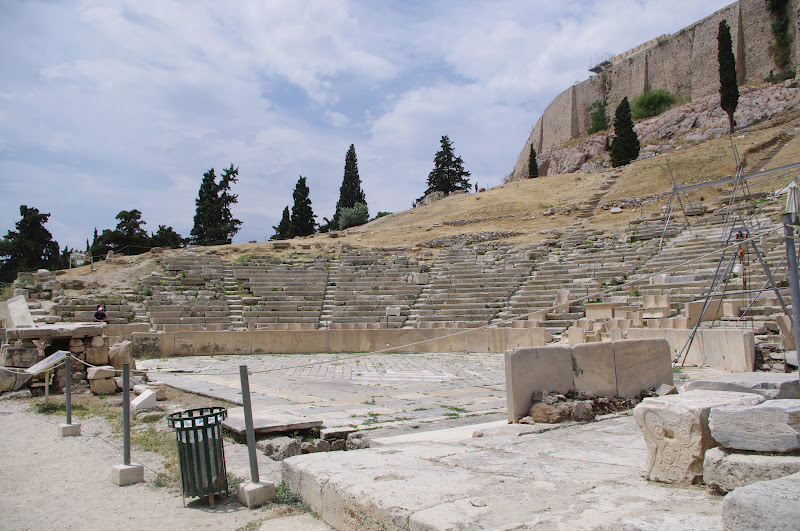
The main highlights of Athens are, of course, the ancient Agora and the Akropolis and we naturally saw both of those, too, along with the temples and massive theater of Dionysus on the south side of the Akropolis. The Agora was the original market area of the city and starting in the sixth century BC, it started to be turned into the administrative center. Most of the remains there now are various government buildings and long stoas built to house the market stalls, all dating from different periods. On a map, it all looks like a confusing jumble of ruins, but walking around the site made it all make a lot more sense to me. Plus, I realized just how big the whole area is!

Parthenon.
The Akropolis, the large flat stone outcrop in the center of the ancient city, is certainly stunning in terms of the quality and size of the ruins, although the effect was marred a bit by large amounts of scaffolding around the Parthenon! As we walked through the entrance, a well-dressed woman asked us if we'd like to hire her for a guided tour on which she would provide extra information not included on the interpretive plaques around the site. I got to say, "I'm actually a classics professor, so I think I have it covered, but thanks!" I felt a little pretentious, but also pretty awesome. The Akropolis was pretty much just as I imagined it being from the pictures and plans I'd seen over the years (although it was certainly cool to be so close to the ruins!). It was a warm sunny day, allowing us to have some nice views over the city of Athens towards the ocean and up towards the mountains. We got a bit too much sun, though, so I was burned on my arms a bit the next day!
Areopagus, where Paul supposedly preached.

We also visited two free ancient sites, the Pnyx and the Areopagus. The Pnyx was the hill where all adult male Athenian citizens met to vote on civic matters. Because it was just an assembly place, there aren't a lot of ruins and there's not much to see - which probably explains why we were the only people there! The Areopagus is a big hill just west/southwest of the Akropolis and it's where, starting in the sixth century BC, trials for murder and sacrilege were held. Again, there's not much there - it's just a hill, but you get some pretty amazing views of the Akropolis and the city. Also, according to the book of Acts chapter 17, the Areopagus is where the apostle Paul preached to the Athenians in the first century AD. (It's a very weird episode in Acts but rather than write a long explanation of it, I recommend you read it for yourself!)

A very impressive 3rd century BCE bronze from the
archaeology museum.
In addition to all the ruins, we also made it to several museums. We started our first day at the National Archaeological Museum, which is a pretty overwhelming place - lots of ancient sculptures and vases, especially. There were some pretty amazing artifacts in there, though, including wall-paintings from the island of Thera that are 3600 years old and a special exhibit on the Antikythera Mechanism, a metal gear-driven mechanism found by archaeologists in an ancient shipwreck. It's in fragments and parts are missing, but it seems to have been a device use to calibrate different calendrical systems and predict eclipses.

View of the Akropolis, filled with people.
At the end of our first day, we went to the new Akropolis Museum just south of the Akropolis proper. It was built about ten years ago in the hopes that the British would return the pieces of the Parthenon sculptures they stole/bought in the early 1800s. It was the Greeks' way of saying, "See, we've got a modern museum better than the British Museum in which to house these things," but the British still refuse to give them back. The museum was very well done with lots of explanations about the buildings and artifacts from the Akropolis, plaster casts of all the surviving sculptural elements from the Parthenon, and an interesting use of space (sadly, no pictures were allowed inside, so we can't show it to you!).
Yogurt and orange juice.

Syntagma Square. Look, Ma! No riots!
The third museum we went to was the Benaki Museum, mainly because it was open till midnight our second day in Athens, giving us something to do in the afternoon once everything else closed. It's a private museum so it's smaller than the two other museums, but they have a pretty continuous collection, from prehistoric Greece to independence from the Turks in the 1830s. However, once we got past the ancient stuff, it turned into a lot of ethnic costumes and decorations from inside houses. I think the whole place is probably of more interest to Greeks or people of Greek descent than to us! But we did have some good Greek yogurt and freshly squeezed orange juice in the museum cafe.
1896 Olympic Stadium.

Because I was more interested in the ancient stuff, we didn't have time to visit any Byzantine-era churches or see much of modern Athens. But we did walk down a street lined with vendors selling almost everything under the sun; we happened to walk past the president's house and the stadium from the first modern Olympic games in 1896; and, on our last night, we hopped off the metro to briefly see Syntagma Square, home of the Greek Parliament, the Tomb of the Unknown Soldier, and protests against the Greek government (although there none while we were there!). Athens was a great city and I'm glad we went. I just wish we had had a couple more days to spend there, looking at things in a more leisurely way than we did!

Bonus picture: a cat Lisa liked.
Bonus picture: Theatre of Dionysus.
Bonus picture: Temple of Olympian Zeus, just because you can
imagine it better.

Monday, May 21, 2012

Reims

Exterior of cathedral with double
windows.
The Monday after our weekend in Versailles, we took the train from Paris to Reims (pronounced "rance"), the biggest city (but not capital) of the Champagne-Ardennes region ("the upstate New York of France" - this marks my ninth region of France and Lisa's thirteenth). It's actually pretty close to Paris and only about a 45-minute high-speed train ride. The most exciting part was that, while transferring between train stations in Paris on the Metro, the metro line just stopped at a station for about ten or fifteen minutes. This added the suspense of "will we make our train or won't we?" In the end, we made it with about ten minutes to spare!

Bibliothèque Carnegie!
The city of Reims was almost entirely destroyed by German shelling in World War I, as it was a key French defensive position on the road to Paris. This means that most of the city is fairly new and there's a lot of 1920s Art Deco buildings constructed after the war. There's even a Carnegie Library in Reims built after the war, complete with a bust of Andrew Carnegie out front and an American eagle and flag on the facade! Unfortunately, it was closed for lunch when we tried to go in, but the historical marker outside made it sound like a beautiful interior with mosaics and stained glass windows.

Interior details with sculptures, looking
out the windows.
Three rows of windows.
The main draw in Reims (as in most northern French cities) is the Gothic cathedral. But this one is a bit different from the other ones we've seen, both historically, architecturally, and decoratively. The cathedral in Reims is where the coronation of the French kings traditionally took place because Reims is the city where Clovis, first king of the Franks, converted to Christianity and was baptized in 496 AD. Architecturally, there are a lot of peculiarities. Among the most obvious and interesting ones are that it has more exterior sculptures than any cathedral other than Chartres. They're everywhere! Above the front doors, there are no relief carvings (as is usually the case); instead, there are three windows directly above the door. On the inside, around the front doors, there are rows and rows of carvings of Biblical figures - the only time we've seen interior carving like that.
Chagall windows.

Because parts of the church were damaged in World War I, most of the stained glass windows are modern. There are a couple by a German artist that were just installed ten years ago and are meant to symbolize German-French reconciliation. The windows in the main chapel behind the altar were done by Marc Chagall in 1974 and remind me of his famous windows at the Art Institute in Chicago. There's also a window commissioned in 1954 by the wine-growers of the Champagne region, in imitation of medieval guilds that would commission windows. One of the side chapels is dedicated to St. Joseph and it has scenes of his life inlaid in lead on the floor, something we haven't seen elsewhere. It was definitely a very distinctive and unique church.
Effect from the windows.

Also unique about the church - we were given an amazingly friendly welcome as we entered. There were two volunteers near the door who handed out brochures to tourists. The woman asked us if we had any questions and gave us a capsule history of the church. It was something we haven't experienced at any other church!

We saw another church in Reims, too, the Basilica of St. Remi. It was originally built as an abbey church to house the relics of St. Remigius, the bishop who baptized Clovis, but was enlarged in the twelfth century. It's a pretty big space without a lot of interior decoration (although the stained glass rose windows are nice). The tomb of St. Remigius is a big stone sepulcher behind the altar. There's also a huge crown-shaped chandelier in the middle of the church with 96 candles in it, one for every year of St. Remigius' life.

Windows in Saint-Remi.
Basilica of St. Remi.
Biscuit rose.
Most things were closed for lunch, so when we had some time to kill, we bought the local Reims specialty - "biscuit rose" which are very similar to lady fingers, but pink.

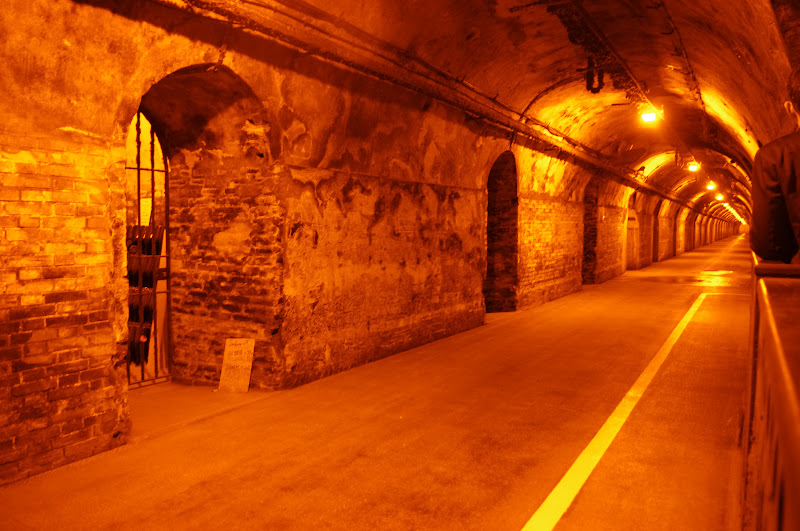
Inside the Mumm caves.
Mumm tasting room.
The other major attraction in Reims is the champagne caves (underground storage and production facilities). In the mid-afternoon, we took a tour of one them, the G.H. Mumm company. The tour was all in French (they have English ones, but the only availability was later in the day, after our train back to Paris left) so I didn't understand all of it, but Lisa did which is good because she LOVES champagne. Actually, the start of the tour was funny because the guide said, in French, "Some of you might be English and I want to remind you the English tour starts in one hour." Then he said the same thing in English. Maybe it's just me, but I would think he should have started with the English announcement in case they didn't speak French! Anyway, it was interesting to see the underground storage areas which have over 15 miles of passageways on two different levels. It was also interesting to see some of the old machinery that was used in champagne production in the 19th century. The tour finished with a tasting. We bought two different kinds. They were good, but we had to gulp them down because by the time the tour ended, we only had 40 minutes to get to our train! We bought a bottle of champagne to share with Jean-Claude and Corinne when we got home that night then ran to the bus stop to get back to the train station. Much like the start of the day, we ended with the suspense of "will we make the train or won't we?" but we made it with about 15 minutes to spare.

Once back in Versailles, Jean-Claude picked us up at the train station to bring us home. Corinne made another wonderful meal, capped with Jean-Claude's excellent fruit crumble and the bottle of champagne we bought. We then watched "Singing in the Rain" because Jean-Claude was appalled I had never seen it and Lisa hadn't seen it since she was a child. He, however, has seen it hundreds of times because he shows it to his classes every year so he went back to the bedroom to read! Still, it was a nice way to end our three days in Versailles. We had such an excellent time with Jean-Claude and Corinne, and they were so generous and kind to us.  We hope to see them again before we return to the States and then to welcome them to our home someday!

Bonus picture: rockstar bish from Saint-Remi.

Saturday, May 19, 2012

A Weekend in Versailles with Jean-Claude and Corinne: French Hospitality


One of the traditional buildings, a carré, in Versailles.
After seeing Saint-Denis, we took the Metro back into central Paris, then took a train from there to Versailles (about a 20-minute ride) where Jean-Claude and Corinne were waiting for us. After dropping off our bags at their lovely two-story apartment, Jean-Claude took us on a short driving tour of the town of Versailles (most of which we didn't see when we were there in April with Chris - we just walked from the train station to the chateau) and then to the chateau itself.

Daffodils and irises growing out of a
thatch roof at the hameau.
Part of the hameau de la reine, like
a movie set.
We visited the parts we hadn't seen with Chris, specifically Marie Antoinette's gardens, the strange little fake village she had built for herself so she could pretend to be a peasant (and which still contains a working animal farm), and her "country house" at Versailles, the Petit Trianon.

Decoration inside the
Grand Trianon.
A stream at the hameau
de la reine: the
fascination with carp
is international.
We also walked down to the Grand Trianon, a substantial house built for Louis XIV, but really used by Napoleon and his family after he became emperor. It was pretty lavishly decorated, much like the main chateau, but much less crowded than the main chateau was when we visited it with Chris. On our way out of the building, we saw ominous looking rain clouds approaching and we made it back to the car just before the rain started pouring! We stopped at the bakery on the way home to get bread for dinner (standard for France!) and then had a wonderful home-cooked meal prepared by Corinne.

A bread line in France.
Cathedral at Versailles.
Sunday was the second round of the French presidential election so after Jean-Claude voted in the morning, he drove Lisa and me into the town of Versailles and took us on a nice walking tour of the central city. Jean-Claude is a middle school teacher with a great love of history and art history, so he was the perfect tour guide. He showed us the school where he teaches then the cathedral. There was a mass going on, though, so we came back about a half-hour later. (Incidentally, I think it's the most well-attended mass we've seen in any of the churches we've visited in France.) It's a 17th-century church that reminds me a lot of the Baroque churches I saw in Rome.

Swiss Basin.
He also showed us the national horticultural school and the "potager," Louis XIV's massive kitchen garden that supplied his palace with food and which still functions today. He took us past the "Swiss Basin," a man-made lake just outside the grounds of the palace created for Louis XIV's Swiss Guards - and around which some sort of race was being run! And he walked us by the old carré, a symmetrical set of four square two-story buildings separated by streets which house shops. We stopped off for more bread, then went home for lunch.
Jean-Claude and Corinne.

Following that, we all took Corinne to vote and then went to the gardens of the palace of Versailles to see the "musical waters." On Sunday afternoons only, they turn on most of the huge fountains in the garden and pump in Baroque music on an extensive sound system. It was a pretty impressive display, especially the one they call "the ballroom," a cascade of water down a series of steps above and around us. We also saw the closing show, the fountain of Neptune.


Our favorite fountain.
The amazing Neptune fountain!
Where Louis XIV was born!
View into Paris.
Once the show was over, we drove to Saint-German-en-Laye, another suburb of Paris north of Versaillles to see what little is left of Henri IV's palace. It's mostly gone, but the room where Louis XIV was born is still preserved - it's now part of a hotel/restaurant and houses several coat racks! The two-kilometer-long terrace of the palace is still there and is now a park, where Jean-Claude used to run as a kid. It's got a great view east to Paris. We also walked around Francis I's palace, now an archaeological museum. We then drove back to Versailles where Jean-Claude and Corinne took us out to dinner at a good restaurant (and while they checked election results on their smart-phones). When we got home, they showed us "The Artist," which Lisa and I hadn't seen. Good thing it's a silent movie and I didn't have to worry about trying to understand a movie in French!

Coming up next: Monday, while Jean-Claude and Corinne went to work, Lisa and I took a day-trip to Reims.
Random: near where Louis XIV was born. Lost or a tribute to baby Louis?

Bonus pictures:
Bonus picture for Lisa's dad:
Marie Antoinette's full-size billiard table.
Bonus picture for Lisa's dad:
remnants of the storm at Versailles.
Bonus picture for Lisa's dad:
how they turn the water on for the
fountains at Versailles.
Bonus picture for Lisa's mom: egg cup
belonging to Marie Antoinette.

Paris: Basilica of Saint Denis

Anne de Bretagne's tomb (with husband Louis XII).
Saturday, May 5, Aaron and I took a train to Paris. The ultimate goal: spend a weekend in Versailles with Jean-Claude (the cousin of both my host-mother in Normandy and my college French teacher) and his fiancée Corinne (congratulations on getting engaged!). First, though, we spent a little time in Paris as Jean-Claude and Corinne had a fitness class in the early afternoon. So Aaron and I took the Metro from Montparnasse (the Paris train station that serves trains coming from western France, i.e., Rennes) to the northern suburb of Saint-Denis. The main attraction in Saint-Denis is the cathedral/basilica where 43 kings of France are buried (plus many queens, royal children, princes, and generals). All but three French kings are buried here, although many of them were exhumed and placed at Saint-Denis long after their death and burial. We were warned by several people that the town itself is pretty rough and dangerous, but it seemed fine from what little we saw. Admittedly, we were there in the middle of the day and the Metro stop is very close to the basilica, so we didn't spend any time wandering the streets.
Anne de Bretagne's transi.
Just part of the gift shop inside the basilica. You can't
really tell, but the whole shop seemed like something
out of New Orleans in a movie.

Anyway, the basilica of Saint-Denis originally dates from the 5th century AD and is dedicated to Saint Denis, the patron saint of France. It became part of a monastery in the 7th century and the church that's there now was built in the 12th century in a grand Gothic style, but unlike other churches we've seen, there's no choir screen and there are no walls between the chapels that surround the front of the church, meaning that light flows into the church unobstructed, making it one of the brightest medieval churches we've been in. We're not sure why Saint-Denis was chosen as the burial site for French kings - if anyone out there knows, help us out and tell us in the comments section! A lot of the tombs are pretty elaborate, especially Louis XII and Anne of Brittany's and Henri II and Catherine de Medici's. In fact, the main reason we went was because I saw a post card way back when during our visit to Nantes that showed the transi of Anne de Bretagne and said I HAD to see that in person. What's a transi? Well, kind of weird. It's part of a tomb (really a big sculptural monument under which someone may or may not be buried). This part of the tomb shows the person's body naked as it is decomposing. The monument also usually includes a sculpture representing the living person in a more prominent and visible spot. Unfortunately, you can't usually get very close to the transis to see them all that well, but I definitely thought the trip was worthwhile.
Some tombs and an example of the light inside the
basilica. Bishop Suger wanted the place to be very
bright, and he succeeded!

Back to the basilica itself. Most of the kings buried there, though, are just scattered bones re-collected after the despoliation of the royal tombs during the French Revolution and buried in the crypt in a big vault. Also in the crypt, you can see the remains of the original 4th-century AD Christian burial ground which I found interesting - Aaron loves REALLY old stuff like that, so it was a good trip for him, too!

Stay tuned for our trip to Versailles with Jean-Claude and Corinne!