Sunday, April 22, 2012

Amiens

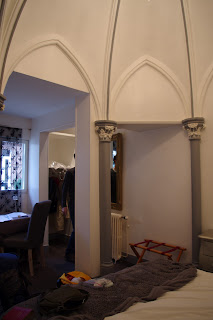
Hotel room at Le Prieuré.
Amiens is about 75 miles to the northeast of Rouen on the Somme River and is the capital of the Picardie region ("the central Pennsylvania of France") - 7/21 regions for me and 11/21 for Lisa. Our train arrived about 7:30 and we walked from the station into the center city. It reminded us both of Cardiff quite a bit: wide pedestrian-only streets with lots of chain stores on either side. Our hotel, Le Prieuré, was just across the street from the cathedral and was absolutely charming. It used to be the priory connected with the cathedral. In fact, our room used to be the monks' chapel, which you can tell from the pictures with the rib vaults in the ceiling. The guy at reception was also very helpful, giving us a map of the city, showing us where the main restaurant area of the city was located, and explaining about boat tours on the Somme for the next afternoon. We took his advice and walked to the main restaurant area along the river and ate at a pretty good place, although it was extremely crowded which made the service slow and absent-minded. It seemed like a very local place and the waiter was very friendly, too. We didn't end up leaving till almost 11!

Street in Amiens.
We slept in the next morning (after our 18-hour day the day before!), went out for breakfast, passed through Amiens' Saturday farmers' market as well as through a square with an Occupy Wall Street encampment. The whole town had a rather British feel to it - lots of red brick architecture in a kind of Georgian or Federalist style. It was very different from the mix of 19th-century stone buildings, medieval wooden buildings, and modern stucco that we've seen in most other cities in France. We then headed back to the cathedral, the main tourist attraction in Amiens (unless you're into World War I battlefields - there are a lot of those in the vicinity, too, apparently).

Amiens cathedral.
For comparison with the other Gothic cathedrals we've seen, Notre Dame in Paris was built primarily between 1163 and the 1240s, Tours Cathedral was begun in 1170 (most of it was done by the end of the 13th century), Chartres Cathedral was mostly built between 1193 and 1250, Rouen Cathedral between 1202 and 1220, and Amiens Cathedral between 1220 and 1270. This means Amiens is the latest Gothic cathedral we've seen and this is important because it explains why it has the tallest nave of any completed Gothic church in France - 139 feet from floor to ceiling, so high it made me slightly vertiginous to look at it. See, each of these towns in northern France was trying to show off their wealth and importance by out-doing their rivals in making a bigger, taller, more impressive church. In being the last town to start a Gothic cathedral, Amiens knew it had to have a higher ceiling than everyone else. (By the way, Beauvais Cathedral, started in 1225, would have been taller - 159 feet, taller even than St. Peter's in Rome - but with the technology and skill available at the time, it couldn't be done without compromising the structural integrity of the whole building. Part of the church collapsed during construction in 1284, meaning only the choir was completed.)
Cathedral facade.

Cathedral interior.
Facade detail.
Anyway, Amiens Cathedral was certainly impressive. In addition to being unbelievably tall, most of the stained glass had been replaced with clear glass, making it fairly light inside. The pavement is all done in white and black tile and contains a labyrinth in the center of the nave. Lisa was the only one to try to walk it besides a six-year-old boy, perhaps because about fifteen percent of it was still covered by chairs. The cathedral once claimed to have the head of St. John the Baptist (stolen by French Crusaders from Constantinople following their capture of the city in 1204) but now only the reliquary is left. The exterior is also different from other churches, with a series of medallions at eye-level on the front facade with different biblical scenes on them. Sadly, the north portal (full of sculptures of the life of St. Firmin, whom Lisa studied for a project in grad school) was undergoing restoration, so we couldn't see the entire exterior of the church. It was also a very windy and chilly day, making it rather unpleasant to stand around outside looking at the facade! Still, it was a very interesting church and we spent an awful lot of time there.

Detail of the floor along with St. Firmin.
When we had our fill (and when we had a train to catch!), we bought some souvenirs from a store on the square in front of the cathedral, including a local Picard battu cake (we didn't like it very much!), got our bags from the hotel, picked up a sandwich-to-go for lunch and took the next train to Lille, another 75 miles to the northeast and the next stop on our whirlwind tour across northern France.
Lisa in the labyrinth.
Look at the height!

Thursday, April 19, 2012

Rouen

Colorful houses in Rouen.
As Lisa and I finished our contractually-obligated hours on April 5th and as Easter vacation began on April 6th, we decided to spend a week traveling across northeastern France to Brussels (where Lisa has a friend from Columbus) to Cologne to Paris (to meet our friend Chris from North Carolina, who was coming to France to visit us). This whirlwind trip included seven cities in seven days and our first stop was Rouen (pronounced "rwahn" - all one syllable), the capital of the region of Haute-Normandie, "the western Pennsylvania of France." For those of you scoring at home, this was the sixth of France's 21 mainland regions I've visited and Lisa's tenth.

Monet's view of the
cathedral.
Getting to Rouen involved waking up insanely early, getting to downtown Rennes to take a 7:15 am bus, then riding for four hours. The reason we put ourselves through this misery was because it saved hundreds of euros over taking the train (which also involved going into Paris, changing train stations, then coming back to Rouen). The bus ride itself was fine, just long. We stopped at a rest area outside of Caen (about half-way through the trip) and once we had all re-boarded the bus, a group of French customs officers got on with a (very happy!) dog who sniffed his way up and down the aisles then the luggage compartments under the bus. We're not sure what they were looking for, but they didn't seem to find anything!

Joan of Arc's tower.
Rouen is located on the Seine River about 80 miles downstream from Paris and is primarily notable for two things: its Cathedral (of which Monet did a series of 30 paintings, in different weather conditions, in the mid-1880s - here's the Wikipedia entry with about half of the paintings) and as the places where Joan of Arc was imprisoned and also where she was burned at the stake as a heretic by the English in 1431. Jimmy and Jenny left us their Rick Steve's guidebook to France (thanks, guys!) and we used that to get us around for our seven hours or so in Rouen.

Neapolitan nativity scene at the art museum--rather
flamboyant!
The bus dropped us off on one of the busy quais along the Seine and we hiked up from there into the central city to the art museum, ate our picnic lunch in the park out front, then went inside to take advantage of the free bag storage there (one of Rick Steve's tips!). The museum itself was surprisingly large and one of the better ones we'd been to up to that point - lots of Renaissance stuff, lots of French Baroque painting of the 17th century (which I don't really care for) and some good Impressionist paintings. The highlight was one of Monet's series of the Rouen Cathedral.

Plague cemetery, complete with dried cat to watch over
the souls.
After the museum, we followed Rick Steve's suggested walking tour, but in reverse (since the art museum was his end point). We walked to the church of St. Maclou, which, unfortunately, was being restored so we couldn't see much of the exterior. Rather than try to go inside we found the nearby Aître St. Maclou, and old 16th-century graveyard for plague victims. The buildings around the courtyard are now an art school but the wooden walls are carved with skulls and grave-diggers' tools. Grisly, but cool, stuff.

Detail from the plague cemetery.

Cathedral.
We then walked to the main attraction, the Cathedral, mostly built in the 13th century but with much of the exterior built in the 16th century. There, too, restoration work was being on the façade so we couldn't see the whole thing. When we thought about these two churches along with the fact that the interior at Chartres is currently undergoing restoration, we almost wished we were here two or three years in the future when all this work would be done! Inside, a service for the Stations of the Cross was being held (it was Good Friday, after all) so we couldn't see much there, either.
The men of Rouen cathedral's facade, hanging out inside
for cleaning.  Everybody needs a bath sometimes, right?

Cathedral interior.

Rue du gros horloge.
We went across the street to the tourist office, got our free map and a couple small souvenirs, then walked up the street to the Gros Horloge, a 16th-century civic clock tower built over the street, passing the Gothic Palais de Justice on the way. At this point, we decided to return to the Cathedral for the last 45 minutes or so of the Stations of the Cross. I had never been to one before - and certainly never to one in French! (I managed to understand a decent amount, though.) At the end of the service, everyone followed the cross into the choir of the church for the last couple stations and it was quite a crowd.
Crack in the ceiling where the
spire came crashing down
during the tornado of 1999.

Following the service, we walked around the cathedral and saw the tomb of Rollo, the first duke of Normandy (he was a 10th-century Viking lord to whom the King of France gave Normandy as a possession) and the tomb where Richard the Lion-Hearted of England's heart is buried. They also had an interesting little display about the freak 1999 day-after-Christmas cyclone that sent the Cathedral's 26-ton spire crashing hundreds of feet through the roof to the floor of the choir below. We also got to see some of the statues of the façade that had been moved inside and to appreciate just how large they are. All in all, it was a cool church and slightly different in style from some of the other Gothic cathedrals we've seen so far.

Palais de Justice, old home of the Parlement de
Normandie.

A Rouen wedding cake--a
rainbow-striped macaroon tower!
We then walked back to the big clock tower and stopped in a (very crowded) candy store, "The Tears of Joan of Arc," for a snack of macarons and then on to the old market where Joan of Arc was burned, passing a surprising number of panhandlers on the way. By this point, it was getting late and we needed to get back to the museum before they closed to collect our bags. We did, then walked up the street to the train station (passing the tower where Joan of Arc may have been imprisoned before her execution) and bought our tickets for the 6:30 train to our next destination: Amiens.


Bonus pictures: 
Lisa, showing the scale of the women.
Aaron, showing the scale of Aaron.

Tuesday, April 17, 2012

Sarah and Lisa's Visit to Paris

Window open at Notre Dame, just in case you need to
make a quick getaway!
To conclude Sarah's trip to France (and our time with visitors), Sarah and I (Lisa writing here), went to Paris for two days so that Sarah could see the capital.  She climbed the Eiffel tower while I was still in Rennes teaching, and then we went to the Square Saint-Jacques (the only time we got a bit turned around and the only place we weren't allowed to do sit-ups!), Notre-Dame, walked all around the Palais de Justice while seeing if we could get into Sainte-Chapelle (we could, but we chose not to), the Arc de Triomphe, the Père LaChaise cemetery, the Tuileries gardens, and the Louvre.  I was very proud of myself for not getting too lost anywhere and for figuring out maps without my geographer husband!  I guess he's taught me something this year.

Square Saint-Jacques, where sit-ups are strictly forbidden.
The Square Saint-Jacques marks one of the routes that head toward Compostelle.  We've visited many cities along the way, and each has seashells marking the path along sidewalks and buildings (we've seen them in Chartres, Tours, Mont St-Michel, Nantes).  At the Arc de Triomphe, we saw an official ceremony of some kind, though what kind, we don't know. 

Hotel de la Porte Dorée.
We stayed at the Hotel de la Porte Dorée as recommended by David and Lily, and it was an excellent choice!  They had bookshelves full for guests on every floor and adorable rooms.  We especially enjoyed the artwork in our room as well as the unique, antique furnishings.

The cemetery was a good way to start Thursday even though it took a while to find the graves.  We visited Chopin, Poulenc, and Apollinaire.  Poulenc was good for both of us since Sarah, a pianist, plays his music, and since I, a lover of Apollinaire's poetry, like the poems set to Poulenc's music.

Sarah taking a picture
of Chopin.
Lisa with Apollinaire.


Sarah's favorite sculpture in the Louvre.
Winter, embodied.
We had absolutely gorgeous weather and enjoyed lunch in the Tuileries gardens while looking at statues and people-watching.  We figured out Sarah's return journey to the airport and then forged our way through the keychain vendors to get into the Louvre, where we saw the Mona Lisa, a lot of sculptures, and an exhibit on some Greek and Roman discoveries in the Rhône river.  All in all, it was a great tour of the city in two days.  It was sad to say good-bye to Sarah because it's the last family time we'll have until Aaron's brother Matt comes and because it was so good to become better friends with Sarah.  We miss her already and look forward to our other visitors in April! 

Monday, April 16, 2012

March is Visitors' Month

This post is written jointly, just for your information and, of course, reading pleasure.

David and Lily in the rain at Fougères.
David, learning all about the history
of Fougères through the children's
information sites.
Much of March was spent hosting visitors, whom we were very grateful to have. First, Lisa's brother David and his girlfriend Lily came for about four days (plus another two and a half in Paris). We showed them around Cesson-Sévigné and Lisa took them to Fougères. This time, the castle was open and they got to go in, but it was cold and horribly rainy! Lily and David also went on their own to Mont-Saint-Michel one day (it helped that Lily speaks French!). It was very nice to have them here and to show them a little bit of Brittany. We made them the traditional dinner of cider, galettes, salad, a cheese course, soup, and baked apples, and by the end we all had eaten too much!  After their days here, Lily and David went to Paris for a few days where they enjoyed picnics in the park and art museums as well as venturing up the Eiffel tower.  It was good to have family time even if that involved what was sadly typical weather.

Fougères intramuros and seen from across the moat.
The next week, my (Aaron writing here) cousin Sarah came and stayed for about ten days. She did an awful lot on her own, too, largely because Lisa and I had to work (obviously) and couldn't accompany her everywhere. She went to Mont-Saint-Michel by herself as well as the Paimpont Forest west of Rennes which is supposed to be the legendary forest of Brocéliande where Merlin is buried. Lisa took her to Vitré one day and I went with her to Fougères so that I, too, could see the castle and the little late medieval church next to it. It was a pretty impressive site and still mostly intact. We also visited a more recent church, St. Leonard, in the upper town which was nice, too. As Sarah said, she was on the "church tour of France" while she was here!

Rennes cathedral, interior.
Saint Amand.  Sarah wanted to know why he was giving
us the finger.
Lisa and I also did a couple things with Sarah in Rennes that we hadn't done before. We went to the cathedral here which is a 19th-century construction done more in an Italian basilica style than a French Gothic style. It's a beautiful space and we also got to see the tomb of one of the first bishops of Rennes, from the sixth century. That week, Andrew (our friend/colleague/son), invited us over for a dinner of traditional galettes and lots of conviviality.  He is a delightful host, and it was a good way to spend time together and to introduce Sarah to French cuisine.

Parliament of Brétagne.
Original entrance hall, Parliament.
The next week, we all took a tour of the Parliament of Brittany building. It was built in the 17th century to house the court of appeals for Brittany as well as offices for tax assessors (the regional court of appeals still meets there). In 1994, the building caught on fire as part of a strike and had to be largely restored and rebuilt. On the tour, we only saw five or six rooms, but they're all decorated with ornate wall and ceiling paintings and one has several tapestries (which we were created after the fire based on the original designs). It's a great building and I'm glad we did the tour, although it was all in French, so Sarah didn't understand any of it and I only understood parts of it! The guide barely took a breath, so there wasn't much time for Lisa to translate. We also had a very strange young man on the tour. When we entered the parliament building, we had to empty our pockets and go through a metal detector. He had TONS of stuff in his pockets and it was all odd things, like a tennis ball, some rope, and a few books. He also consistently lagged behind the rest of the tour, being the last one out of a room as we walked and he even pulled out a newspaper to read during one stop on the tour. We were vaguely concerned that he was looking to case the building for some not-so-peaceful purpose. It was very strange.
Ceiling, Parliament.
Modern furniture in an old-fashioned room, Parliament.
Aaron with window from Chartres for scale.
On the weekend, we went back to Chartres and this time we got to see the stained glass museum, which turned out to be about a lot of windows and a very out-of-date exhibit in the basement that was supposed to stop running two years before.  It was still interesting and gave us the chance to see reproductions of the Chartres windows that were too high to be accurately read from inside the sanctuary.  Our hotel was very cool, as it was an old monastery and had a book sale, where we over-indulged on Old French and Latin books.  It seemed like all the octogenarians had emptied out their shelves for this sale, and we were grateful!  The other cool thing about the hotel was that the year prior, an American group of pilgrims had built a labyrinth out back to mimic the one that was inside the church and which is almost always covered with chairs.  We got to end our visit there with a nice walk through that.

Sarah and Aaron in the labyrinth at our hotel.


Crypt, Notre Dame de la Couture.
Notre Dame de la Couture,
Le Mans.
On the return trip, we had a long enough layover in Le Mans that we finally got to see a bit of that city where we've spent collective hours, but only minutes at a time.  The church we visited was actually quite beautiful, with no aisles.  It felt very open as a result.  We ran into the sexton and complimented him on the church, at which point he offered to light up the crypt for us, which was very old, much older than we expected.  We can now officially say we've been to Le Mans!

Stay tuned for Sarah and Lisa's Visit to Paris.

Bonus Picture: Sarah and Lisa's favorite moment from the Parliament tour.
Dog Sees Pigeon, Boy sees Dog, Mom sees Boy.  On your mark, get set, go!

Sunday, April 15, 2012

Lunch in Saint-Sulpice

Lisa and Margaret.
The weekend after our trip to Tours, one of our colleagues, Margaret, invited us to her house for lunch. Margaret is a recently divorced British woman with two young daughters and she lives in Saint-Sulpice, a little town north of Rennes. Since the bus service there is rather spotty on weekends, she kindly came to our house to pick us up.

Charlotte, who not only knows fashion
rules but also enjoys playing in puddles.
Lunch was lovely. Lisa got to play with a cat, I got to play her piano, we heard a mix of French and English (Margaret spoke English, her girls spoke mostly French), and we learned, thanks to her oldest daughter, that it's something of a fashion rule in France that you can't wear more than two colors at once. No wonder everyone knows we're not French before we even open our mouths!

On our afternoon walk we avoided
being trampled by a horse.
After lunch, we went for a short walk in a large forest not far from their house. It was a sunny day, but cool, and we didn't walk far or long. I'm sure the forest would be much more pleasant now that spring has come to Brittany and plants are in bloom! Before leaving, Margaret loaned us some books and some classical CDs, which was very kind of her. On the way home, we stopped off at a ruined medieval abbey in Saint-Sulpice. It wasn't as impressive as Tintern Abbey, naturally, but it was a nice way to cap a lovely Sunday afternoon.
Part of the abbey.
The abbey ruins.