Monday, November 21, 2011

Rome: Surrounding the Ancient Center

Since you've now seen the ancient center of Rome, we'll take you on our walking tour around it.

Santa Maria di Loreto
(aka Mary in a papoose).
Click to enlarge.
On the north side of the Forum of Trajan (one of the Imperial Fora) are two small round churches, both of which we decided to visit while we were in the area. One of them is Santa Maria di Loreto, which included a chapel with a fairly modern statue of what appeared to be Mary in a papoose. We have no idea what the meaning of this statue is (nor can we find anything about it on-line), but Lisa says its one of the coolest thing she saw in Rome.

Circus Maximus.
South of the Palatine (the posh place to live in Republican Rome, then the area of the imperial palace complex in the empire), we could see the Circus Maximus, the site of chariot races in ancient Rome. When I lived in Rome eight years ago, it was just a large green park for joggers and dog-walkers, but today it appears to have been taken over by the Carabinieri (Italy's national police force) for some reason. They had helicopters, planes, tanks, and trucks on display there but I have no idea why.


We told the truth, so we kept our hands!
The inside of S. Maria in
Cosmedin was equally
worth seeing!

We did two other things of interest near the Palatine and the Circus Maximus. First, we visited the Bocca della Verità ("the Mouth of Truth"), also immortalized in Roman Holiday. It's a large stone face (probably a medieval drain-spout) in the porch of the church of S. Maria in Cosmedin. According to legend, you put your hand in the mouth, someone asks you a question, and if you're lying it bites off your hand. There were many Japanese tourists there when we stopped by and I also don't remember there being a security guard and metal gates to form lines when I went eight years ago. Still, we got our picture there.

San Nicolas in Carcere.
Sanctuary, San Nicolas in Carcere.
Substructure of ancient temples.
The other thing we did was to go inside the church of San Nicolas in Carcere. This is located between the Bocca della Verità and the Capitoline (the site of the largest and oldest temple in Rome). It's built on top of an ancient Roman temple and in fact, you can see from the outside how the columns of the temple were incorporated into the exterior wall. Inside, it's a perfectly normal Roman church, but you can go down into the crypt for two euros a person. I initially didn't want to do this (I thought there were more interesting things to see elsewhere), but Lisa suggested we ask the care-taker if we could go down. He said we could (although he seemed a little put out by it), he opened the gate, and he led us (and three other Italians) down. At first, it seemed like a small, normal crypt, without much to see, and it was rather disappointing. Then, the caretaker disappeared through another door, marked with a sign that said, "If you want to go past this point, you must pay 5 euros." We thought, great, another scam to get us to part with more money. However, everyone followed the caretaker and he didn't ask for more money. Behind the door, we were led into an excavated area under the church where we could see the actual foundations of the second-century BC temple the church is built on as well as the two temples on either side of it. The guide led us all around the exterior walls of the church, showing us the foundations, the columns, and other architectural fragments from the ancient temples. There were also maps and descriptions set up at various places, which helped immensely since he only spoke in Italian, making it hard for us to follow his description. Regardless, I thought it was one of the coolest things we did in Rome, so thanks, Lisa, for insisting on going down!
Original Roman pavement in the crypt of San Nicolas. The
ground level was much lower in ancient times.


Pyramid of Cestius.
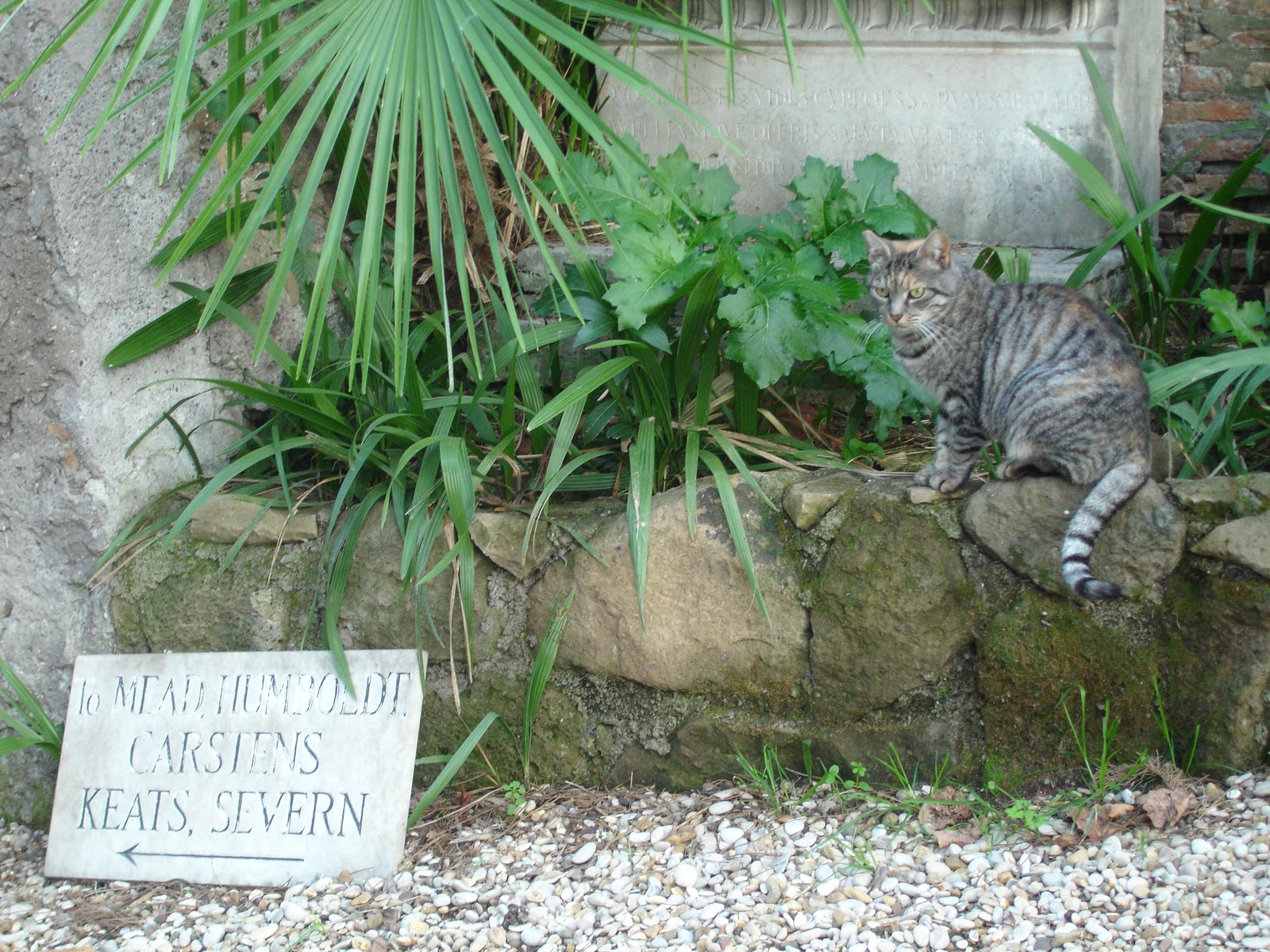
Cat, directions to graves.
Further south from that, we walked to the Pyramid of Cestius, the grave of a late first-century BC aristocrat who really like Egypt and wanted his grave to be in the shape of a big pyramid. The real reason I wanted to go there, though, is because it's connected to the Non-Catholic Cemetery in Rome which is another cat sanctuary (I wanted to be sure Lisa got her fill of cats! Lisa thinks this is because he fears she will adopt a French one if he doesn't find others for her to visit.). Unfortunately for her, there weren't as many cats there as in Largo Argentina, but fortunately for us, we were able to see the graves of the poets Shelley (who, unfortunately for him, died at sea off the coast of Italy) and Keats (who, also unfortunately, died of tuberculosis in Rome).

Pottery on the Monte Testaccio.
On the way back up into Trastevere for dinner, we passed Monte Testaccio, which was formed between the first century BC and the third century AD entirely out of broken pottery. It stands near the Tiber River at the point where 70-liter clay jugs of imported olive oil were unloaded from ships, poured into smaller containers, then stored. Once the large 70-liter jugs were emptied, they were broken down and dumped in the carefully organized trash pile of Monte Testaccio which is 115 ft high and contains an estimated 53 million olive oil jugs. That means that in the third century AD, Rome was importing about 7.5 million liters of olive oil a year! Also, according to Wikipedia, in the 19th century, caves were dug into the hill in order to keep wine cool during the hot Roman summers. The porous structure of the hill, made up as it is of pottery sherds, created a kind of ventilation system that kept the interior cool. It kind of makes you wonder what people two thousand years from now will be doing with our garbage heaps, doesn't it?

Sunday, November 20, 2011

Rome: The Ancient Center

Statue of Marcus Aurelius
on the Capitoline Hill.
First off, be prepared for a history lesson as you read this blog! (Or, of course, you can just look at the pretty pictures. And remember, if you just want to see those, you can click on any of them to enlarge them and then click through them all.) We began our tour of the ancient center on the Capitoline Hill on November 1 (All Saints' Day), which is a national holiday in Italy. Therefore, they had shut down the Via dei Fori Imperiali (the large wide street running between the Colosseum and the Capitoline) to cars in order to turn it into a large pedestrian area for the day. And boy, were people taking advantage of that! The Capitoline Hill was the site of the largest and oldest temple in Rome, the Temple of Jupiter Optimus Maximus, and is now the site of a museum and the huge Victor Emmanuel monument (dedicated to the first king of the united Italy and pictured in the previous blog entry as the sign to restrooms in Rome).

Climbing the Palatine, one can see the foundations and
segments of the wall of the imperial palace.
From there we went to the Palatine Hill (we certainly got our exercise in that day!), which in Roman mythology, was the location of the cave where Romulus and Remus (the twin founders of Rome) were nursed by a wolf after being abandoned. Archaeologists have found evidence of human habitation on the Palatine dating to about 1000 BC. In the Roman Republic (5th century to 1st century BC), the Palatine was home to many aristocrats and Augustus, the first emperor, had a house here. After his death, emperors continued to live on the Palatine, adding more land and buildings to house the various imperial offices until the whole hill was the residence of the emperor. Hence our English word, palace.

Hippodrome, Palatine Hill.

This next picture is the so-called "Hippodrome" (because it looks like a horse-racing track) in the part of the palace built by Domitian in the 90s AD. It's not clear what this was used for, but we know it wasn't for horse-racing. It was probably a huge sunken garden.


Foundations and walls of the Severan Palace.
Still climbing, we came to the foundations and walls of the Severan part of the palace, built by the Severan family of emperors in the early third century AD. As the hill had become too small to house all the bureaucrats vital to running the empire, the emperors extended the palace off the hill into the plain below by constructing several-story-high buildings on the plain that connected with the structures on the hill.

Baths of Caracalla.
Looking out, we caught a view from the Palatine looking towards the Baths of Caracalla (built in the early third century AD). This is one of my favorite sites in Rome, but unfortunately, we didn't have time to go there. Aaron talked about how much he loved this place, and thus Lisa will always remember it as the place we didn't go.

We made a stop for some of Rome's abundant water supply with all that walking! Climbing down the north-west side of the Palatine leads to the Forum Romanum, the "downtown" area of the ancient city. Located in a depression between the Palatine and Capitoline Hills, the Forum was originally the city's main commercial, political, and judicial center. People could buy food here, watch trials being conducted, and hear the recent business of the Senate (citizens could not attend Senate meetings but could wait outside the building to hear the results of debates). Over time, it became packed with monuments and temples erected by various politicians and emperors.

The Arch of Titus over the entrance to the Forum Romanum. It was built by Emperor Domitian in about 82 AD to commemorate the victory of his brother, the late Emperor Titus, over the rebellious Jews in 70 AD. Part of the carvings depict the carrying of the spoils of war from Jerusalem into Rome, including the Menorah from the Temple in Jerusalem. Click to see the detail.
This is one of the first major ruins you see on the left side of the Forum, the Temple of Castor and Pollux.


This is part of the Temple of the Deified Julius Caesar, which faces the main square of the Forum. This particular column base is thought to mark the spot where Caesar's body was cremated following his assassination. As you can see, people still lay flowers there in his honor.


View from the Temple of the Deified Julius Caesar across the Forum. The big building in the background is actually on the Capitoline Hill so you can see how the Forum runs right up to the foot of the hill.

A view just to the right of the one above, this one shows the triumphal Arch of Septimius Severus, dedicated in AD 203 to mark Severus' victories over the Parthians in modern-day Iraq.

Continuing around the north-west side of the Forum, this is taken from the front of the Senate House at the north-east corner of the Forum (near the Arch of Septimius Severus) looking across the main square.
The Basilica Nova, north-east of the Forum on the main road out towards the Colosseum. This was begun by the Emperor Maxentius in AD 308 and completed by Emperor Constantine in AD 312 after he defeated Maxentius. It was the largest building in the Forum and this picture gives you a good sense of its overwhelming size.


Between the Forum and the Colosseum is the Temple of Venus and Roma, a huge double temple begun by the Emperor Hadrian in AD 121.

This is a view from the Colosseum looking back towards the Forum. The street on the right side of the picture is the Via Sacra, the main entrance to the Forum. On the left is the Arch of Constantine built to commemorate his victory over Maxentius. Much of its sculptural elements were removed from older arches and put on this arch. In the center of the picture is the round base which once supported a colossal statue of the Emperor Nero (later changed to an image of the sun god after Nero's death). The name "Colosseum" actually derives from this Colossus and didn't originally refer to the size of the Colosseum at all!

In the first and second centuries AD, several emperors constructed new fora that extended north and east off the original Forum Romanum. The purpose of these new fora (the Imperial Fora, as they're called) was, first, to demonstrate the power and wealth of the emperor and, second, to provide more public space to conduct trials and official business. This is a picture of part of the Forum of Augustus and the Temple of Mars Ultor, built by Augustus and dedicated in 2 BC.


This is a view of part of the Forum of Trajan (with the Column of Trajan in the background), the last of the Imperial Fora built in 112 AD. Unfortunately, many of these imperial fora lie buried beneath a major street, the Via dei Fori Imperiali, making full excavation virtually impossible.


The Markets of Trajan, a three-story shopping center built into the side of the Quirinal Hill on one side of the Forum of Trajan.

The last major site in the ancient center is the Colosseum, which lies to the south-east of the Forum Romanum. Constructed between 72 and 80 AD, it was the largest amphitheater built in the Roman Empire. It was begun under the Emperor Vespasian, the first emperor after Nero who held power for more than a few months. Nero had constructed a massive palace for himself which occupied most of the city of Rome. One of the goals of Vespasian's reign was to dismantle this palace and give much of the land back to the people of Rome. The Colosseum was part of that strategy as it sits on the site of what was Nero's private lake.


The interior of the Colosseum showing the walls and the substructure of the spectator stands. The Colosseum could hold between 50,000 and 70,000 people.


A view of the structures beneath the arena floor. These structures housed store-rooms for weapons, cages for wild animals, and an elevator system to bring gladiators and animals up to the floor of the arena.


A view of one through one of the arches into the center of the Colosseum.

Saturday, November 19, 2011

Rome: East of the Via del Corso and the Quirinal

Victor Emmanuel Monument, whose Winged Victories
let tourists all over Italy know where to find free restrooms.
The Via del Corso is the straightest and widest street in central Rome, probably because it was laid out by the ancient Romans. It runs from the Capitoline Hill (now the site of the Victor Emmanuel monument) to the northern city gates (now the Piazza del Popolo), with the Campus Martius on the west side of the street. According to Goethe's Italian Journeys, the was used for riderless horse-races during the Roman Carnival in early 19th-century Rome, hence the name "Corso" (race-course). Because of its size, the street today is home to many large chain stores and is a major artery for foot traffic through north-central Rome. Therefore, what's interesting isn't the street itself but what's on the side streets on the eastern side of the Corso.

Spanish Steps.
One of the side streets leads to the Piazza di Spagna and the Spanish Steps, immortalized in countless photographs and movies (Roman Holiday and The Talented Mr. Ripley to name just two). This is one of the most touristy parts of Rome because everyone has to see the steps for some reason. It was amazingly crowded when we visited on the first day and, since we hadn't gotten used to the street-vendors by that point, we were hustled into buying some roses. While the process of buying them was annoying, at least I bought my wife flowers on our honeymoon!

Trevi Fountain.


Another side street leads to the Trevi Fountain, the biggest and one of the most famous fountains in a city full of them. (Incidentally, Lisa and I greatly appreciated the many free public drinking fountains located throughout the city, very unlike anywhere we've been in France where finding free drinking water is nearly impossible! These numerous fountains are largely due to the fact that Rome has had an amazingly well-functioning and ample supply of water for thousands of years. Except, you know, when the barbarians destroyed the aqueducts in the early Middle Ages!) Like the Spanish Steps, the Trevi Fountain is one of the "must-see" tourist stops for some reason and the day we went was like any other. The piazza was crowded with tourists looking at the fountain and taking pictures. This means that, unlike my first stay in Rome, we were unable to get close enough to the fountain to throw in a coin which supposedly guarantees that one will return to Rome. I think we'll be okay, though.

Barberini Fountain. Click to
enlarge so you can see the bees!
I also took Lisa to see another fountain east of the Via del Corso in the Piazza Barberini, the Fontana del Tritone. This was commissioned by Pope Urban VIII, a member of the Barberini family, and carried out by the famous sculptor Bernini. The fountain is quite lovely, but the main reason I wanted to show it to Lisa is because it includes the Barberini coat of arms and part of that is a series of three bees, one of Lisa's favorite animals.

Marble inset from San Andrea--the
only image we've seen in a church
where someone is holding a mirror!
While walking from here back towards the Piazza Venezia, we walked along one side of the Presidential Palace on the Quirinal Hill and stopped in the church of San Andrea al Quirinale. It was a lovely little round church, but we had not studied up on the Secret Rome book we had been lent and so (apparently) missed the best parts of the church: the sacristy, the relics of St. Stanislas Kostka, and a black-and-white marble statue of the saint on his deathbed. Let this be a lesson to you: read guidebooks in advance!

The Anglican Church even had the requisite kneelers
cross-stitched by church ladies!
Another church we visited east of the Corso was the Anglican All Saints Church, mainly because I know Lisa enjoys visiting Anglican and Episcopal churches when she has the chance. As we entered the church, I had a strange feeling that I had been there before, and then it hit me. I had been there before, during my time at the Centro! The church is very close to the Italian national academy for opera singers and the students regularly perform opera pieces (without all the sets and costumes, of course) in the church. Early in my time at the Centro, a number of us had gone to the church to see a student production of the highlights of Verdi's La Traviata - but I had no idea it was in the Anglican Church until I returned there! At any rate, the church was unlike the many Catholic churches we saw, which is understandable. There was a lot less marble, a lot more wood, and a more English Gothic feel (rather than an Italian Baroque feel) to it.

Between the church and the Corso, we passed an English-language bookstore (The Lion Bookstore) and decided to stop in. As Lisa commented to the cashier (a nice British fellow about our age), we've really missed browsing in English bookstores here, something we didn't realize till we were there. I picked up a copy of some of Joseph Conrad's shorter fiction which was heavily discounted as part of a moving sale. The cashier was very pleasant and in fact, on our last morning in Rome, before heading to the airport, we were wandering near the Campo de' Fiori again when we ran into him on his bike. He stopped and said hello, asked how much longer we were staying, wished us a safe trip, and invited us to come back to the store next time we're in Rome (although we'll have to figure out where it's moving, since he wasn't sure himself where they'd be going!). He was another in a line of very friendly and welcoming residents of Rome who helped make our time there so enjoyable.

Bonus picture: The Last Supper alla Barbie (seen near the
Print Fair).

Sunday, November 13, 2011

Rome: The Campus Martius

The current Roman Stock
Exchange, built into the
temples of the divine
Hadrian, 140s AD.
The Campus Martius is the name for the large, flat, marshy area lying between the Tiber River and the hills and Forum of Rome. In antiquity it was originally the place where adult male Romans would assemble several times a year for military exercises and to vote, but over the course of the Roman Empire, it became built up with monuments, as it was one of the few open places left in the city in proximity to the downtown. During the Middle Ages, most of the population of Rome gradually moved from living on the hills to the east of the Campus Martius to the Campus Martius itself because it was closer to the Vatican (and thus to the source of authority and security in the medieval city).
Fiori at the Campo de' Fiori.

Carciofi e orange at the Campo de' Fiori.
Today, much of the Campus Martius has a medieval feel (like Trastevere) with old buildings and narrow streets, but it's also where many of the offices of the Italian government are located (including Parliament), as well as touristy shops and restaurants, the stock exchange, Renaissance palazzi, hotels, and ancient monuments. A mixed bag, really. One of the first places we visited in the Campus Martius was the Campo de' Fiori, the old flower market which still serves as a small food market every morning. It was packed with tourists but they had some amazing-looking produce. We also visited the Largo Argentina, in the middle of which is an open excavation of four third- and second-century BC temples. It also doubles as a cat sanctuary since cats in Rome have the right to live where they're born. It was thus a nice treat for both of us; I got to take pictures of ancient ruins, Lisa got to meet some cats.

Friday, November 11, 2011

Rome: Getting There and Trastevere

On the high-speed train, we took a
moment to enjoy the chocolates we
bought from a local chocolate-maker
in Rennes--lemon for Lisa, raspberry
for Aaron. Just like the wedding cake!
Getting from Rennes to Rome proved to be a slight adventure because two days before we were scheduled to leave, the flight attendant unions for Air France decided to go on a four-day strike to protest proposed lay-offs. This meant that our flight from Paris to Rome was canceled. After being unable to re-book tickets through the Air France website or through their phone line, we found the Air France office in Rennes where a very nice travel agent got us on another, earlier flight. Once we got to the Paris airport, however, our flight ended up being delayed by about an hour while Air France waited for some of the flight attendants who were not on strike to show up to work. In the end, we got to Rome at almost exactly the same time as our original flight would have gotten there. Incidentally, I really don't understand how Air France can keep 80% of its flights running (which is what they claim they did) if their flight attendants are on strike. I guess not all the flight attendants were on strike. (Also, in the confusion at the Paris airport, I managed to lose Lisa's stainless-steel water bottle for which I'm very sorry. Lisa [Lisa's comments throughout are in italics.] is adding as she looks over this before posting that it's equally her fault for forgetting it on the seat.)

We took a cab from the Rome airport to our lodging and we were treated to a wonderful ride by a very friendly man named Rocco. It turns out that his wife is French, meaning he spoke French much better than he spoke English or than we spoke Italian. He said he lived in Trastevere (the part of Rome directly across the Tiber from the historic center) and said we should try to eat our dinners at some of the small hosterias there. He also arranged to pick us up on Friday morning to take us back to the airport, which solved one of my transportation worries.

The only place we've ever
stayed without a Bible in
the nightstand....and this
was a convent.
Aaron, preparing for our
adventures. We made a king-
size bed with the two twins.
We stayed at the convent-guest house of the Sisters of Carità di Santa Maria just to the south-west of the Vatican near the Stazione San Pietro. I would highly recommend to any looking to visit Rome look into staying with them or with one of the other convents or monasteries listed on Monasterystays.com. The sisters were friendly, the accommodations were very clean, we had a private bathroom, and, most importantly, it was much cheaper than a comparable hotel in central Rome. The one potential downside is that this convent (and many others, too) has a curfew at 11 pm because they don't give you a key to get through the building's outer gate; a sister has to buzz you in. Lisa and I aren't exactly late-night partiers, though, so the curfew didn't bother us at all. In fact, we were usually in by about 9:30 (Lisa was even asleep by 8:30 one night!) and we were usually wide awake by about 6:30 or 7 am (partly because of the excitement of being in Rome, but also, I think, because we switched from Daylight Savings Time the night before we left Rennes). One of the nuns spoke French so Lisa could communicate with her (although she was confused for several days as to why we had American passports but were coming from France!).

A ricotta and pear cake. Subtle flavor,
perfection.
The first night, we found a restaurant nearby, the Osteria dei Pontefici, which, true to its name, had paintings of the walls of the last six or seven popes. It was a large place and seemed to cater to tourists (which makes sense, given its proximity to the Vatican) but the food was still pretty good.

The weather while we were there was very lovely - sunny and low 70s every day. It was a welcome change from the cloudy, cold, rainy weather in Bretagne!

Via della Scala, Trastevere.
Breakfast. Mmmm.
Italy, where the hot chocolate is
almost a solid. Click to enlarge if
you don't believe us!
From this point on, Lisa and I have decided to write a geographical narrative, going neighborhood by neighborhood through what we saw, rather than doing a chronological approach (which we're afraid would turn in just a list of "And then we went here. And then we went here.") So I'll start with Trastevere. Trastevere is a very medieval-y part of Rome with narrow, winding, pedestrian-friendly streets and old three-story buildings. It's become much more touristy than I remember it being when I lived in Rome eight years ago. Every night we were there, we saw plenty of Germans and Americans walking around (although, to be fair, there is an American university in the area so there's a large population of American students in Trastevere). We ended up eating most of our dinners in the neighborhood, although some places were better than others. I even managed to find one of the restaurants I used to frequent on Saturday and Sunday nights when I studied at the Centro. At the time, we didn't know its name because it was never prominently displayed; we simply referred to it as "the place across from Il Duca" (a restaurant across the street). I now know its name is Cacio e Pepe. The meal we had there was quite good, with grilled vegetables as antipasto (which were fabulous! Some of them were pickled or cured first and had lots of spices on them!), spaghetti alla carbonara for me and gnocchi ai quatro formaggi for Lisa, followed by a small glass of sambucca for Lisa as an after- dinner drink (despite its size, it delivered a powerful message....early sleep). We also had breakfast in at a cafe in Trastevere one morning. I had a cappucino and a ciambella (large Italian sugared doughnuts) and Lisa had an excellent cup of cioccolata calda. Also, we spent part of our last night in Rome at the same cafe each enjoying a glass of wine outside and watching the street life.

Mosaics in Santa Maria in Trastevere.
Downstairs in the pharmacy,
via della Scala.
While Trastevere looks very medieval in some ways, it's also become the home of lots of little boutique stores, several of which we visited, including a Turkish glass shop, an English-language used bookstore, and a paper/stationery story (which I, Lisa of course adored! I purchased a little book with my favorite florentine pattern, and now I've written my favorite poems in it so that I can work on memorizing them on my walks to and from school). One of the real medieval treasures of Rome, though, is the church of Santa Maria in Trastevere. The church dates back to the third century AD, making it one of the oldest churches in Rome, although most of what's there now is from the 12th and 13th centuries, including some beautiful medieval mosaics. Another amazing place we only glimpsed was a 17th-century pharmacy, still functioning today. It was run as a free clinic by the Carmelites all those years ago, and today it runs as a normal pharmacy as well as a neighborhood clinic. If you take the time to go upstairs, you can see some amazing frescoes. We didn't know/forgot how to get to that part (according to Secret Rome, a guide lent to us and partly translated by our colleague Vicki, you just go upstairs or ask if you can't find the stairs), but the inside was still decorative with paintings and marble. We also spent a little time one evening in the church of Santa Maria della Scala in order to rest our feet a little bit before dinner (we walked everywhere, meaning we were walking at least six miles a day!). Beyond that, though, Trastevere was really a neighborhood in which to eat and shop.

Sunday, November 6, 2011

Back from the Honeymoon!

Carciofi alla giudia e pizza.  Molto bene.
We made it back from Rome, where we had an absolutely amazing time! We saw the Roman marathon (that's now two races in Europe I've seen and should have known about beforehand!), ate lots of pasta, walked at least six miles every day, and saw more churches and ancient ruins than I thought possible. We'll put up specific posts about places we saw, but for now, here are a few pictures, and a map of everywhere we walked. (We only took one bus and used the metro once! We got to see a lot more of the city that way.) Stay tuned for more!
Image courtesy of goparoo.  It's not the clearest, but the navy dots
show you how much we saw!

The Vatican, outside of Saint Peter's.
Colosseum.

Rome, my kind of city.  All cats have
the right to live where they are born,
without being bothered by any
official business.